
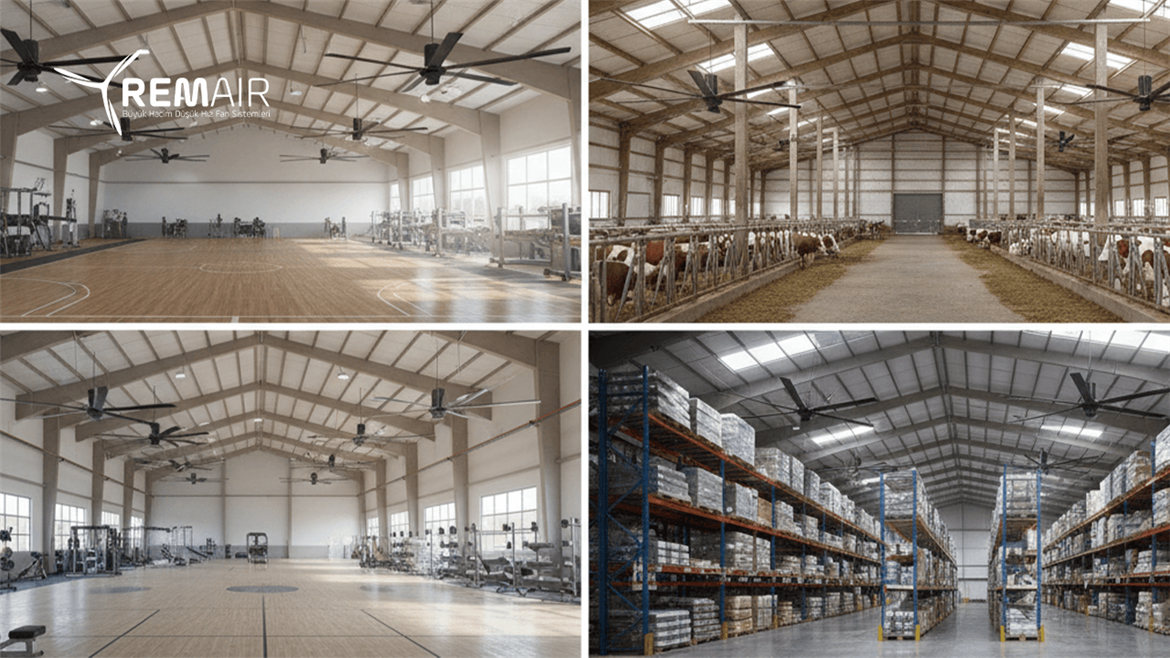
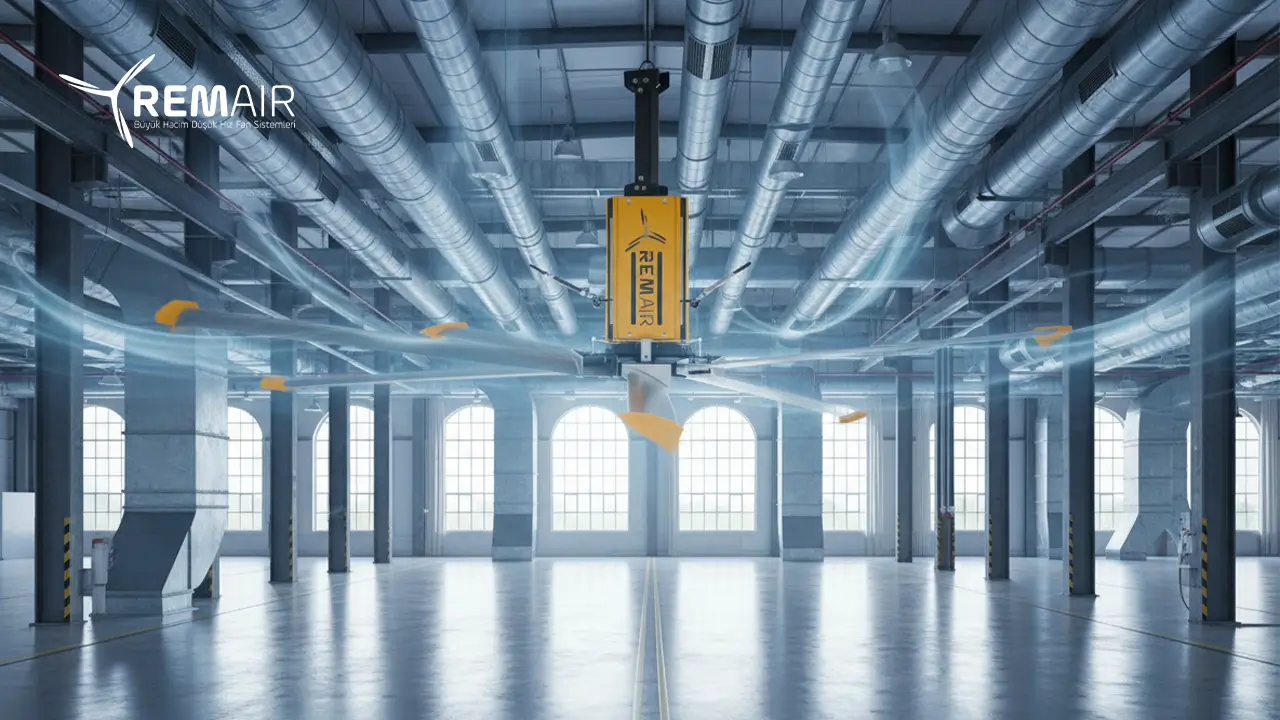
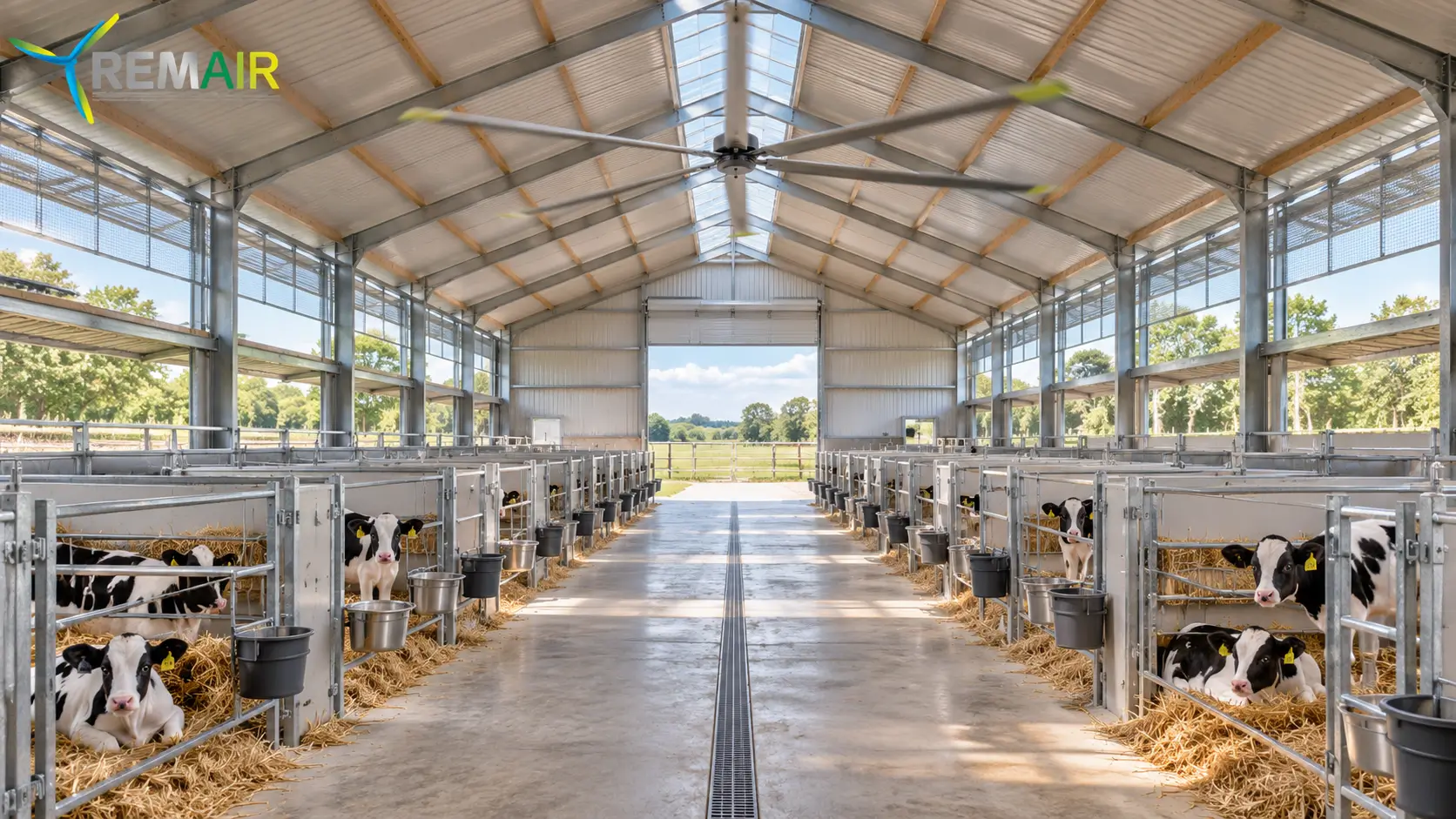
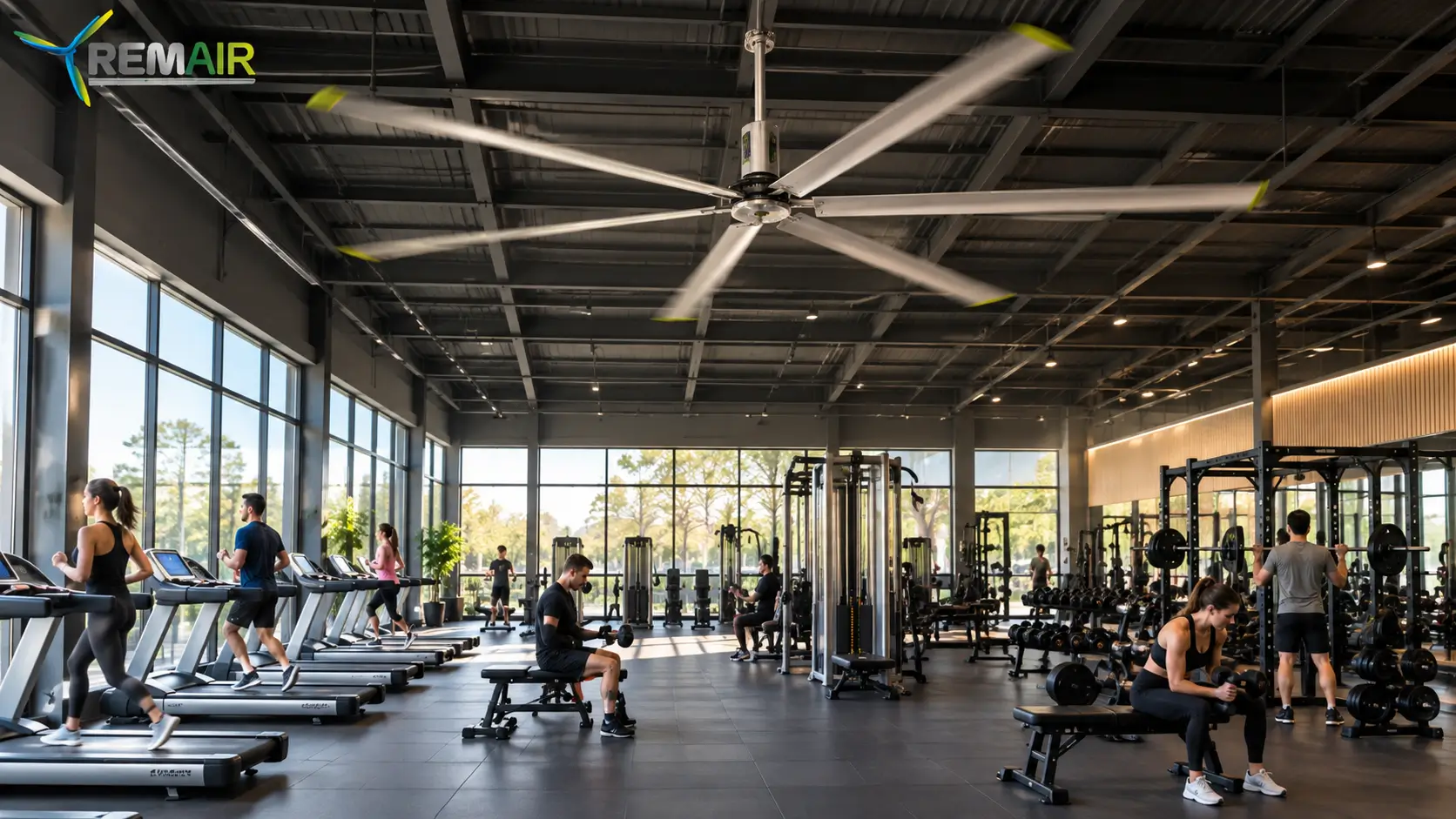
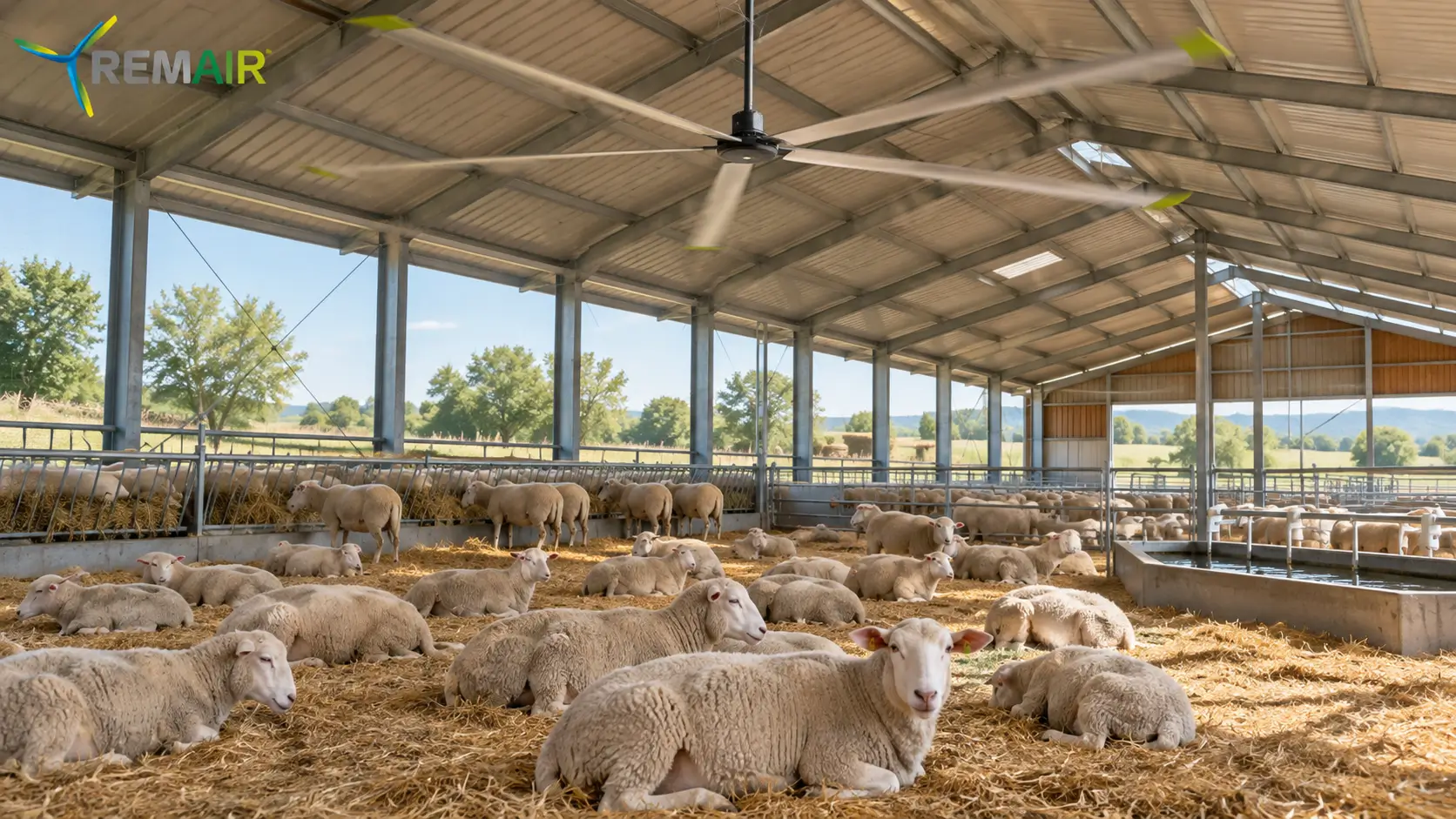

For a 1,000-square-meter enclosed area, typically one or two HVLS fans are sufficient. Fan diameter, ceiling height, and airflow direction are the main elements that determine this number. In wide and open single-piece structures, one large fan can cover the entire space, while in partitioned or long corridor-type layouts, using two fans ensures more balanced air circulation.
An ideal ceiling height enhances airflow and helps determine the correct number of fans. In tall buildings, airflow spreads across a wider area, meaning even a single fan can be effective. However, beams, equipment layouts, and design elements must not obstruct circulation.
When positioning the fans, energy efficiency should be considered along with the cooling effect. Using more fans than required increases both the initial cost and energy consumption. With proper airflow direction, even a single fan can create a strong circulation effect. Therefore, selecting a model that matches the physical characteristics of the space is the most accurate approach.
The Most Suitable HVLS Fan Diameter for a 1,000 m² Enclosed Area
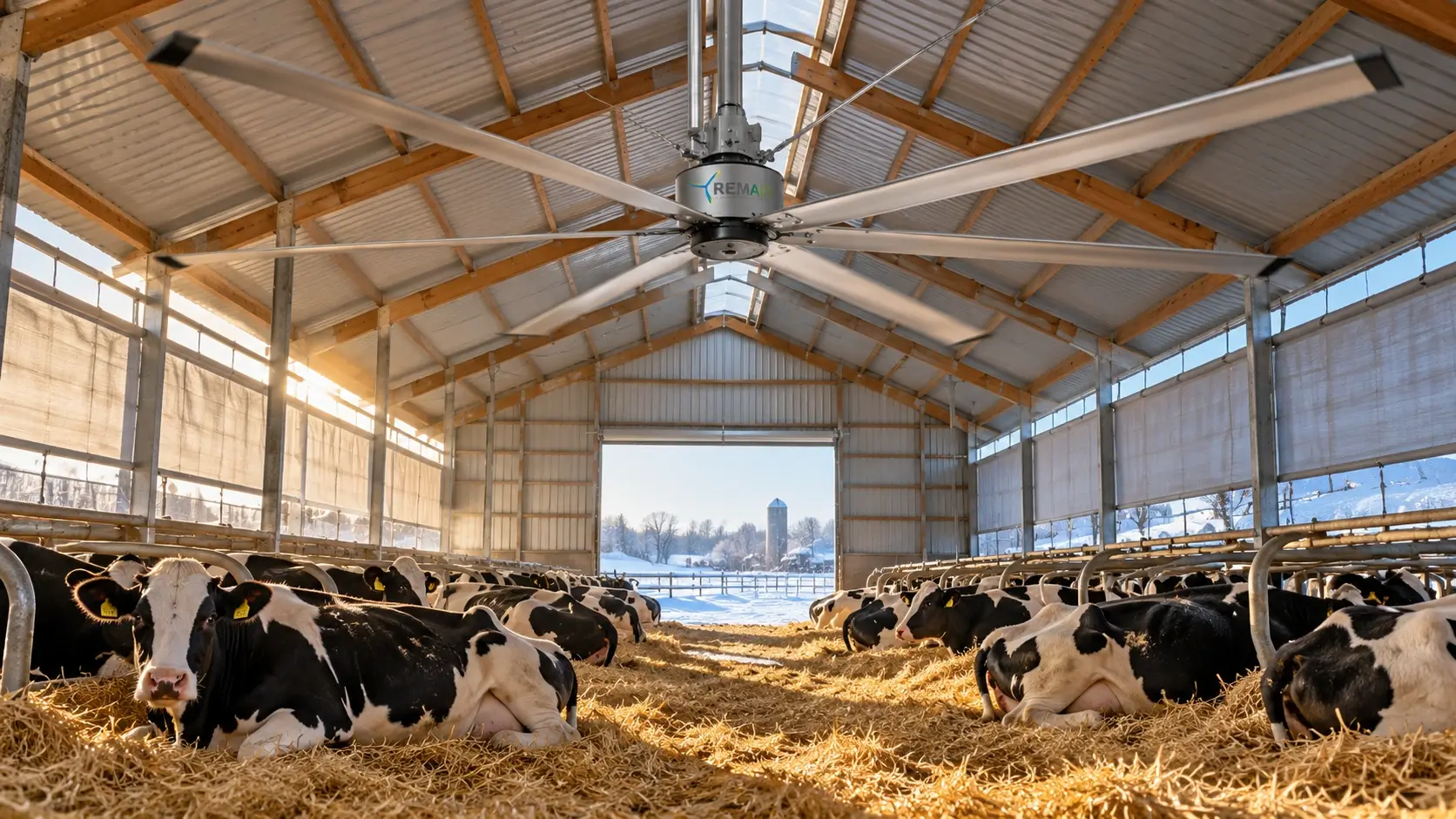
Large-diameter HVLS fans provide more effective results in enclosed areas around 1,000 square meters. Typically, 6–7 meter models are preferred, as they distribute airflow evenly across the entire space. These fans generate high-volume airflow at low speeds, ensuring consistent circulation throughout the environment. Large-diameter models offer uniform climate control, particularly in intensive-use areas such as livestock barns, storage facilities, and production sites.
The structure of the space and the ceiling height play significant roles in determining fan diameter. As ceiling height increases, larger-diameter models become more prominent as they allow airflow to spread more widely. Positioning the fan at the center also enhances efficiency and prevents unnecessary energy loss. Choosing the correct diameter strengthens the cooling effect while keeping energy consumption under control, resulting in long-term comfort and economic benefits.
How to Determine the Number of HVLS Fans Based on Ceiling Height?
Ceiling height is one of the most critical criteria when determining the number of HVLS fans. In tall structures, airflow spreads across a wider area, making a single large-diameter fan sufficient in most cases. However, if the ceiling is low, airflow becomes more restricted, requiring additional fans to evenly ventilate the area. Therefore, the distance between the ceiling and floor should be carefully calculated when planning fan placement.
In medium-height structures, more flexible options are available. Either a single large fan or two medium-diameter models may be preferred. What matters is evenly distributing airflow across the entire space. In barns, warehouses, or production areas, physical obstacles must not block airflow. If necessary, fan count is increased depending on the form of the space to support circulation.
In lower-ceilinged enclosed areas, airflow direction requires careful planning. Since devices must be mounted at a limited height from the floor, smaller-diameter models can be installed at various points to ensure adequate circulation. This prevents hot spots and balances energy consumption. When fan selection does not match the ceiling height, airflow becomes inefficient; proper planning ensures both comfort and energy savings.
Which Works More Efficiently: One Fan or Two?
In large and open-plan structures, a single large HVLS fan is often sufficient. Large-diameter models create powerful airflow even at low speeds, producing uniform circulation throughout the area. If the ceiling height is ideal, the airflow generated by one fan reaches all corners while maintaining energy efficiency. This approach delivers effective results with a simple installation, especially in barns, storage facilities, and production sites.
In partitioned or long corridor-type spaces, using two fans provides more balanced airflow. When physical obstacles do not block circulation, two fans support each other to create stable air movement throughout the space. This placement eliminates hot spots and contributes to a more comfortable indoor environment. When choosing between one or two fans, the structure of the space, ceiling height, and airflow requirements should all be evaluated together.
Factors Affecting HVLS Fan Count in Partitioned Buildings
When determining the number of HVLS fans in partitioned buildings, interior architecture, ceiling height, and walls or equipment that disrupt airflow must be carefully assessed. Each section may require its own airflow, directly influencing fan placement. Therefore, in structures where a single device cannot distribute airflow to all areas, each section should have balanced circulation within itself. This prevents hot spots and ensures stable airflow throughout the entire building.
Main factors affecting fan count
- Number of partitions and whether they are open or closed
- Walls, doors, and equipment that disrupt airflow
- Floor area and ceiling height of each section
- Whether airflow between sections is possible
- Purpose and usage intensity of the structure
Using the correct number of HVLS fans ensures strong airflow even in partitioned areas. This approach enhances energy efficiency and maintains uniform climate control across all sections. As a result, regardless of how complex the interior design is, proper planning helps preserve ideal airflow throughout the structure.
When Is It Necessary to Use Additional Fans?
Additional fans become necessary when existing circulation does not reach the entire area. In spaces where physical barriers limit airflow, installing an extra device eliminates hot spots. Similarly, in high-usage environments where a single fan cannot generate sufficient airflow, an additional fan helps maintain balance. This approach enhances comfort and ensures the cooling effect is evenly distributed throughout the space.
Situations requiring additional fans
- Partitioned or walled structures where airflow is divided
- Long and narrow corridors where a single fan is insufficient
- Areas with varied ceiling heights causing weakened circulation
- Spaces with heavy equipment blocking airflow
- High temperature or humidity accumulating in specific zones
A circulation system supported by additional fans creates a more stable environment throughout the building. This method improves energy efficiency in large-volume structures and delivers climate control that meets user expectations. As a result, both comfort and environmental quality are improved.
Common Mistakes When Selecting HVLS Fan Capacity
One of the most common mistakes when selecting HVLS fan capacity is failing to accurately assess the actual needs of the space. Focusing only on square meters without considering ceiling height prevents the airflow from achieving expected performance. This increases energy consumption and weakens the cooling effect.
Another mistake is choosing a fan diameter that is too small or excessively large. Small models underperform in wide areas, while overly large fans result in unnecessary energy usage. Therefore, selecting capacity without evaluating space form, equipment density, and interior architectural details does not yield efficient results.
Incorrectly determining the number of fans is also a common issue. While it may seem that one device can ventilate the entire space, this approach fails in partitioned structures. Physical obstacles blocking airflow make the consequences of improper capacity planning more apparent.
Fan placement is another factor often overlooked. Even if the correct capacity is selected, improper positioning results in unbalanced airflow. Therefore, evaluating all characteristics of the space during capacity planning provides optimal comfort and energy efficiency.
Frequently Asked Questions
1. How many HVLS fans are generally sufficient for a 1,000 m² area?
In most cases, one large-diameter HVLS fan is sufficient. When positioned in a tall and open space, it ensures homogeneous airflow across a wide area.
However, if the structure is partitioned, contains many columns, or has a low ceiling, using two fans provides more balanced results and reduces dead air zones.
2. Is a single fan sufficient for cooling?
In open and single-piece structures, a properly sized HVLS fan is often sufficient for cooling, as it generates noticeable airflow even at low speeds.
However, if machines, walls, or shelving units block airflow, adding an extra fan becomes the correct approach for balanced distribution.
3. What is the most critical factor when determining the number of fans?
The most critical factor is ceiling height. As height increases, a single large fan can effectively circulate air across a wider area.
Along with ceiling height, the width of the space, usage type, and interior layout should also be assessed to determine both fan number and diameter.
4. How does partitioning affect fan count?
If the space is partitioned, each section may act as a barrier to airflow. In such cases, a single fan may not be sufficient.
Depending on section size and usage density, each area may require its own fan or fans may be strategically positioned across multiple sections.
5. Is a large-diameter fan sufficient on its own?
A large HVLS fan can be sufficient on its own in many wide spaces when correctly positioned. Its broad blade structure produces comfortable airflow even at low rotation speed.
However, the form of the space, internal layout, and high-density areas should also be evaluated. Additional fans may be installed in targeted zones if necessary.
6. Is an extra fan needed for very high ceilings?
Generally, no. In high-ceiling structures, a large-diameter HVLS fan pushes warm air accumulated at the top downward, creating strong airflow and improving comfort.
This enhances cooling sensation and increases the efficiency of existing HVAC systems. Additional fans may be required only if space width and layout demand it.
7. What can be done if there are zones with weak circulation?
Additional fans are an effective solution for zones where airflow is weak or interrupted.
Especially in long corridors, narrow passages, or areas with tall shelving, a secondary HVLS fan or auxiliary fans help balance airflow and improve comfort.
8. Does using more fans increase energy consumption?
Yes. Using more fans than necessary directly increases energy consumption. Therefore, fan count should always match the actual need.
With proper planning, using fewer but correctly positioned HVLS fans provides energy savings while delivering the desired comfort level.
9. How is fan count determined in barns or warehouses?
In barns, warehouses, and factories, fan count cannot be determined solely by square meters.
The width of the structure, ceiling height, interior layout, usage density, and partitioning must be assessed together to determine both fan count and diameter accurately.
10. Is professional calculation necessary?
If the space has a complex design or is used for multiple purposes, a professional assessment is recommended.
This ensures correct fan quantity and optimal placement, avoids unnecessary energy consumption, and maximizes efficiency.

Leave a Comment