
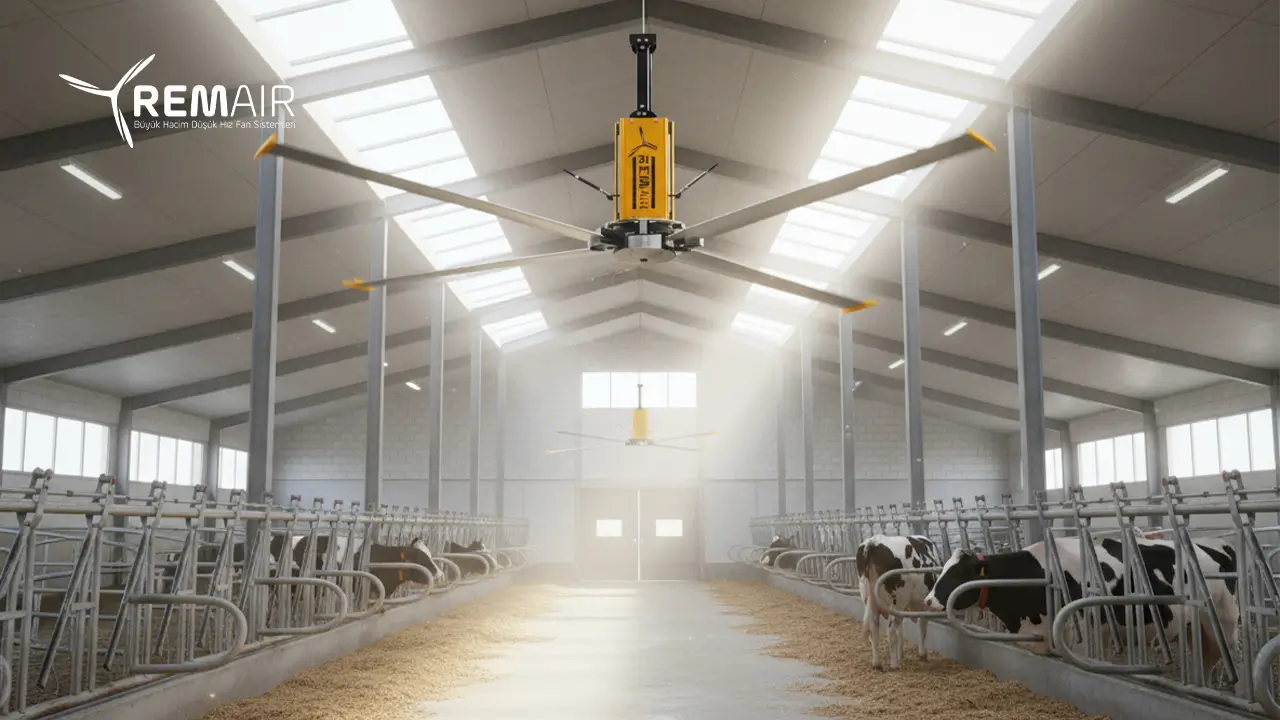
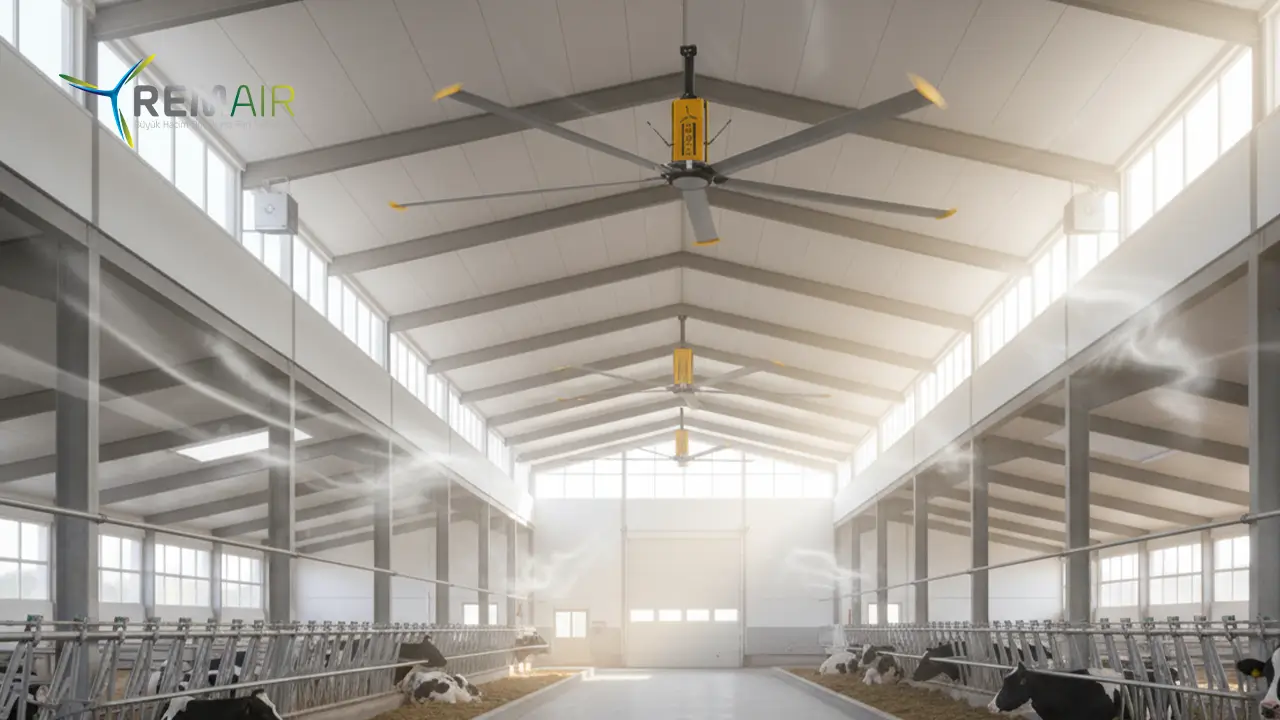
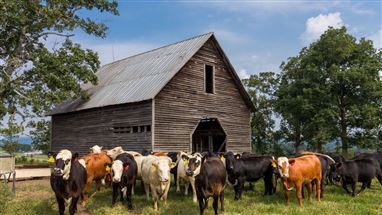
Air change rate is the measure that shows how many times the total air volume of a space is replaced with fresh air within one hour. The calculation is quite simple: when you divide the hourly ventilation flow rate (m³/h) by the total volume of the space (m³), you obtain the ACH value. For example, if there is a system in a barn with a volume of 500 cubic meters that provides 2000 cubic meters of air circulation per hour, the ACH value is 4. This figure means that the air in that space is completely renewed 4 times per hour.
Determining the correct ACH value in barns and industrial facilities is critically important for both animal health and worker safety. Insufficient ventilation triggers the accumulation of ammonia, carbon dioxide, and moisture, which leads to respiratory diseases and productivity losses. On the other hand, excessive ventilation causes energy waste and, during winter months, increases heat loss and puts animals under stress. The ideal ACH value varies depending on the intended use of the space, the density of living beings or machinery inside, and climatic conditions.
In practice, there are a few points to consider when calculating ACH. First, the net volume of the space must be measured accurately; the ceiling slope, columns, and fixed equipment should be taken into account. Then, the actual airflow rate should be determined based on the existing fan capacities or natural ventilation openings. Once you obtain these two data points, applying the formula is sufficient. However, the numerical result alone is not enough; the obtained value must be compared with industry standards and, if necessary, the system should be optimized.
What Is ACH and Why Is It Important?
ACH, short for "Air Changes per Hour," is a technical term that expresses how many times the air in an enclosed space is replaced with fresh air within one hour. In Turkish, it is also referred to as "saatlik hava değişim sayısı." This value is one of the most fundamental indicators used to measure the effectiveness of ventilation systems. Especially in places where air quality is critical, such as barns, factories, hospitals, and food production facilities, ACH calculation stands out as a mandatory engineering parameter.
In enclosed spaces, living beings or machines constantly pollute the air. Animals produce ammonia and carbon dioxide, while industrial processes release dust, vapor, and chemical particles. The accumulation of these pollutants increases health risks and also causes productivity losses. When adequate air circulation is not provided, the immune system of living beings in the environment weakens, machine performance decreases, and dangerous conditions arise for workers.
The correct ACH value is determined according to the function of the space and the density inside it. A barn on a dairy farm and a factory where chemical production is carried out do not have the same ventilation requirement. Every sector has its own specific standards and legal regulations. Therefore, when calculating ACH, it is not enough to simply apply the mathematical formula; it is also necessary to consider the operating conditions of the space, climate factors, and industry requirements.
While insufficient ventilation leads to serious consequences, excessive air exchange also increases energy costs and disrupts heat balance. This is exactly where the importance of the ACH value becomes clear. Achieving the optimum level offers the most efficient solution both economically and in terms of health. Professional ventilation planning is essential to establish this balance.
ACH Calculation Formula and Practical Example
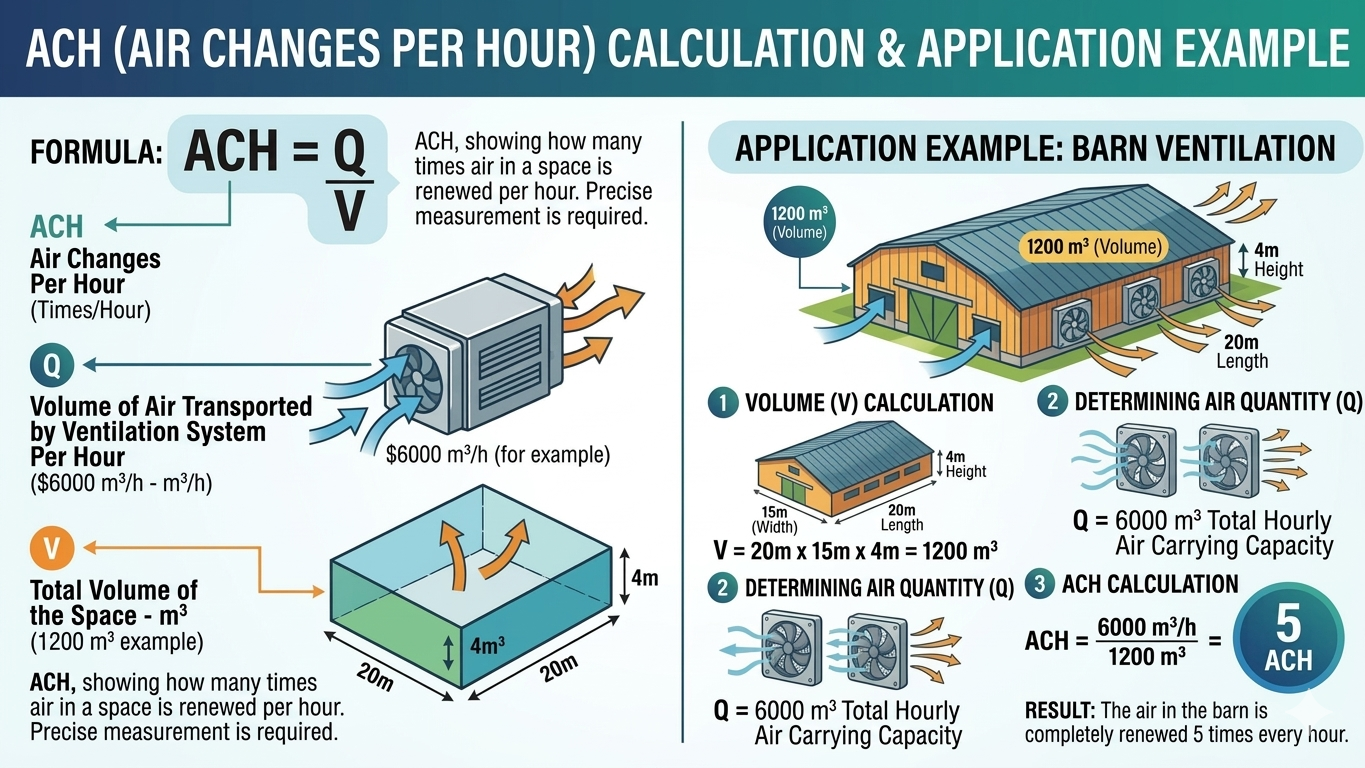
The formula used to determine the hourly air change rate is quite simple: ACH = Q / V. In this equation, Q represents the amount of air moved by the ventilation system per hour (m³/h), while V refers to the total volume of the space (m³). The result shows how many times the air in that area is renewed within one hour. Although the formula appears simple, both values must be measured precisely to obtain the correct result.
Let’s proceed with a practical example. Imagine a barn that is 20 meters long, 15 meters wide, and 4 meters high. The volume of this space is 20 x 15 x 4 = 1200 cubic meters. If the fans used in the barn move a total of 6000 cubic meters of air per hour, the ACH value is calculated as 6000 / 1200 = 5. This result means that the air in the barn is completely replaced 5 times every hour.
There are certain points to consider when making the calculation. When calculating the volume of the space, ceiling slopes, columns, and the area occupied by fixed equipment should not be ignored. In addition, fan capacities should be evaluated not according to theoretical values, but according to their performance under actual operating conditions. Incorrect measurements lead to the system being undersized or oversized, which both increases costs and prevents the desired air quality from being achieved.
Required ACH Values in Barns
The ideal air change rate in barns varies according to the type of animal housed and seasonal conditions. For cattle, a value between 4 and 6 per hour is considered sufficient during winter, while in summer this figure can rise to between 15 and 40. In small livestock farming, the values are generally kept somewhat lower. According to widely accepted standards, the minimum ACH value in cattle barns should be 4 in cold weather and at least 15 in hot weather. These figures have been determined by taking into account the animals’ metabolic heat production, moisture release, and ammonia formation.
When determining the correct ACH level, it is necessary to consider not only the animal type but also the density in the barn. As the number of animals per square meter increases, the ventilation requirement also rises. In addition, the climatic characteristics of the region, the insulation condition of the barn, and the existing ventilation infrastructure are among the determining factors. Systems that remain below standard values invite respiratory tract infections and productivity decline. For this reason, in barn projects, ventilation calculations must be carried out with professional engineering support during the design phase of the structure.
Problems Caused by a Low ACH Value
In environments where the ventilation system is insufficient, air quality deteriorates rapidly. Especially in barns and factories, this directly affects both the health of living beings and production efficiency. When adequate air circulation cannot be provided, harmful gases and moisture accumulating in the environment cause serious problems. Here are the main issues triggered by a low ACH value:
- Ammonia accumulation: Ammonia gas released from animal waste reaches dangerous levels when ventilation is insufficient and triggers respiratory diseases.
- Excessive humidity level: In environments where the air is not sufficiently exhausted, moisture accumulates, creating ideal conditions for the growth of fungi and bacteria.
- Heat stress: Especially during summer, hot air becomes trapped in the space and creates a stifling environment for animals and workers.
- Carbon dioxide concentration: The CO2 produced by both animals and machines, when not exhausted, reduces oxygen levels and causes fatigue.
- Dust and particle accumulation: Feed dust, skin particles, and industrial residues remain suspended in the air, preparing the ground for chronic respiratory disorders.
- Loss of productivity: Animals under stress produce less milk and gain weight more slowly; in factories, worker performance declines.
- Spread of disease: In stagnant air environments, pathogens easily pass from one living being to another and the risk of outbreaks increases.
All these problems create a chain reaction. Minor issues that go unnoticed at first gradually turn into major economic losses and health problems that are difficult to compensate for. For this reason, it is vital that ventilation systems be checked regularly and that the ACH value does not fall below standards. Early intervention both reduces costs and ensures a sustainable production environment.
ACH Differences in Large and Small Livestock Farming
The ventilation requirements of large-bodied animals such as cattle and buffalo differ significantly from those of smaller species such as sheep and goats. This difference is based on many physiological factors, from the animals’ body weight to metabolic heat production, moisture release, and ammonia formation. Even in two barns with the same square meter area, if the housed species changes, the ventilation system must be recalculated. Here are the main ACH differences between the two groups:
- Metabolic heat production: Large livestock release much more body heat and therefore require intense air circulation in hot weather. In small livestock, heat production is relatively lower.
- Recommended ACH range: While a target value between 15 and 40 is aimed for in cattle barns during summer, 8 to 15 is generally considered sufficient in sheep and goat shelters.
- Humidity tolerance: Small livestock are more sensitive to humidity. This makes it necessary to remove moisture quickly even at low ACH values.
- Ammonia threshold: Large livestock produce more manure and therefore ammonia emissions increase. Ventilation capacity should be sized accordingly.
- Shelter density: In small livestock barns, the number of animals per square meter is generally higher. This increases the ventilation requirement per unit area.
- Seasonal flexibility: While there is a major difference between summer and winter ACH values in cattle barns, this difference remains within a narrower range in small livestock shelters.
It is not correct to apply a one-size-fits-all ventilation solution for both animal groups. During the project phase, the animal type, number, and regional climate conditions must be evaluated. Otherwise, either health problems arise due to insufficient air exchange or energy is wasted with systems that are more powerful than necessary. Establishing the right balance positively affects both animal welfare and business profitability in the long term.
Common ACH Calculation Mistakes
The most common misconception in ventilation projects is the incorrect calculation of the space volume. Most people simply multiply length x width x height and consider the job done. However, sloped roofs in barns and machine rooms and fixed equipment in factories significantly change the actual volume. When these details are overlooked, the ACH value that appears correct on paper becomes completely misleading in practice.
Another critical mistake is relying on catalog values for fan capacities. The figures provided by manufacturers are data obtained under ideal laboratory conditions. In actual operating environments, fans perform far below this level due to dust accumulation, filter clogging, and duct losses. Ignoring this decrease in calculations directly paves the way for the system to be insufficient.
Failing to take seasonal differences into account is also a common problem. Determining a single ACH value and running the system with the same settings throughout the year leads both to energy waste and animal health problems. It should not be forgotten that lower air change rates are needed in winter and higher rates in summer. Variable-speed controlled systems or staged fan arrangements are the most effective ways to solve this issue.
Finally, not including natural ventilation in the calculations is a major deficiency. Airflow occurring through windows, doors, and roof openings is usually ignored. However, these sources make a serious contribution to total air exchange, especially in mild climates. Evaluating mechanical systems together with natural circulation both produces more accurate results and prevents unnecessary equipment investments.

Leave a Comment