

Ventilation in sheep barns has two functions: in summer, moving air over the animals to reduce heat stress; in winter, removing indoor moisture and ammonia without creating drafts. Although these needs may seem opposite, both are solved by the same principle — keeping air moving continuously and in a controlled manner inside the barn. In summer, this movement should be noticeable at animal level; in winter, it should pass above the animals’ backs.
The most common mistake in practice is to close the barn completely in winter and open it completely in summer. In a closed barn, moisture and ammonia accumulate and respiratory diseases begin to appear in the flock; in a fully open barn, air can become stagnant at summer noon and shade alone does not provide sufficient cooling. Below, we explain how sheep respond to heat stress, what poor ventilation causes inside the barn, which solutions work for open, semi-open and closed barn types, and how fans should be positioned in practice.
How Do Sheep Respond to Heat Stress?
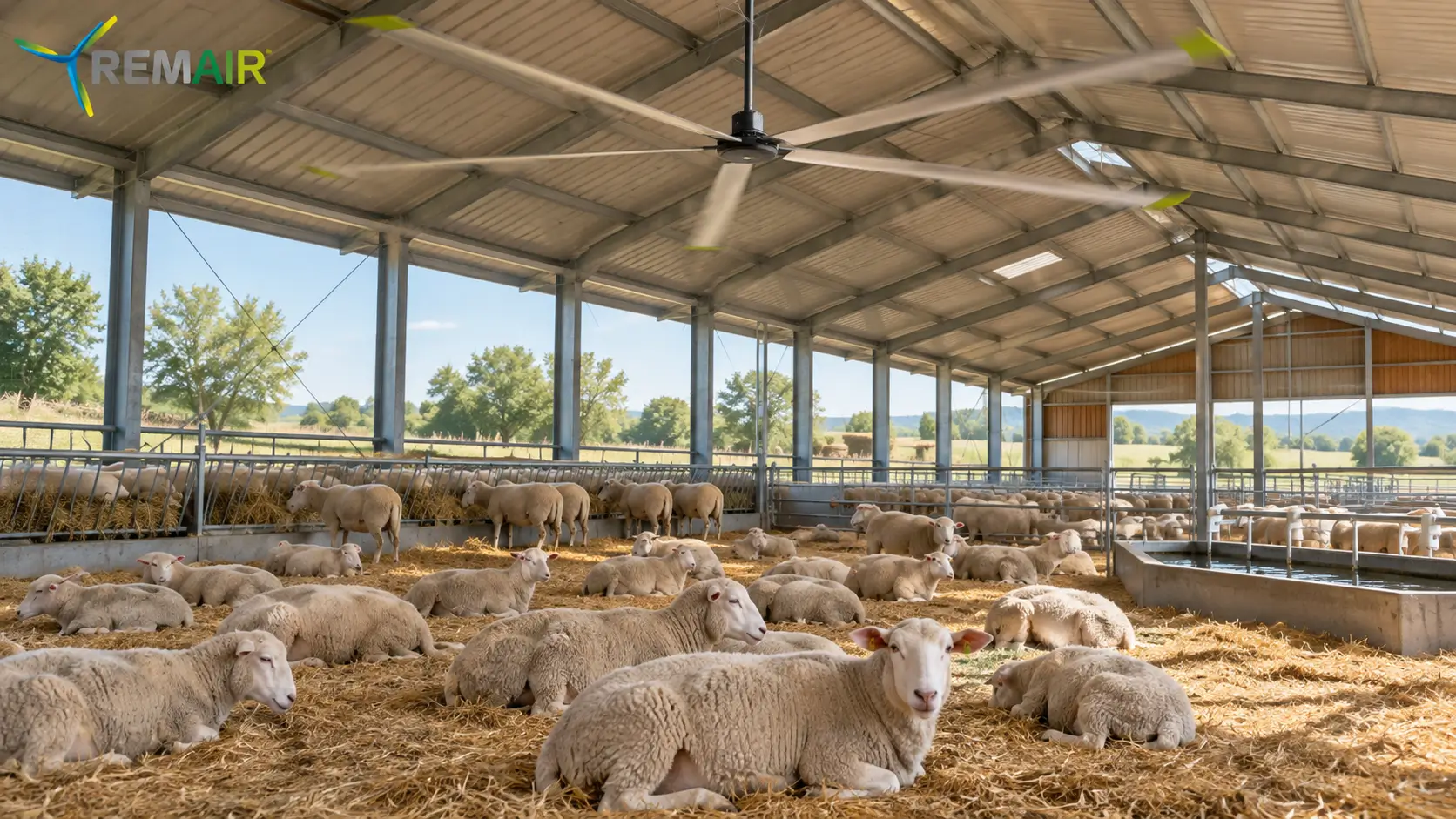
Thanks to their fleece, sheep are highly resistant to cold; the real challenge is heat. Because fleece acts as an insulating layer, it makes it harder for the animal to dissipate body heat. Sheep also have limited sweat glands, so cooling takes place largely through respiration.
The first signs of heat stress are visible: increased breathing rate, open-mouth breathing, reduced feed intake, crowding around waterers, and gathering in the shade while remaining inactive. By the time these signs appear, productivity losses have already begun.
The impact of heat stress on production can be grouped into three areas:
- Feed intake and live-weight gain decrease. Animals avoid eating in hot conditions; daily weight gain declines in fattening lambs.
- Milk yield and milk quality decline. In lactating ewes, both milk volume and dry-matter content decrease.
- Reproductive performance is adversely affected. This is the most costly consequence. In rams, sperm quality is directly affected by heat and recovery can take weeks; in ewes, embryo loss increases during the early stages of pregnancy. Poor results from mating at the end of summer are often caused by heat stress experienced in July and August.
Problems Caused by Poor Ventilation in Sheep Barns
Odor is the first sign of insufficient ventilation, but the main damage occurs where it cannot be seen.
Moisture accumulation. Sheep continuously produce water vapor through respiration and from the bedding. If this moisture is not removed, relative humidity rises, the bedding becomes wet and condensation begins on the walls. Relative humidity inside the barn should generally be kept between 50–80%, preferably around 60–70%. For moisture control, the methods described in our article on how to reduce barn humidity are also applicable to sheep barns.
Ammonia. Urine breaks down in wet bedding and releases ammonia. Ammonia irritates the respiratory epithelium, weakens the animal’s defenses and increases susceptibility to bacterial infections. By the time the human nose can detect ammonia, the concentration is already considered high for the animals.
Respiratory diseases. When moisture, ammonia and dust occur together, cases of pneumonia increase. Loss rates are especially higher among lambs. In enclosed barns, winter coughing outbreaks are usually caused not by cold itself, but by inadequate ventilation.
Bedding and hoof problems. Bedding that remains continuously damp causes hoof softening and creates favorable conditions for foot diseases. For flooring and bedding management, see our article on how barn flooring should be designed for more information.
The Difference Between Natural and Mechanical Ventilation
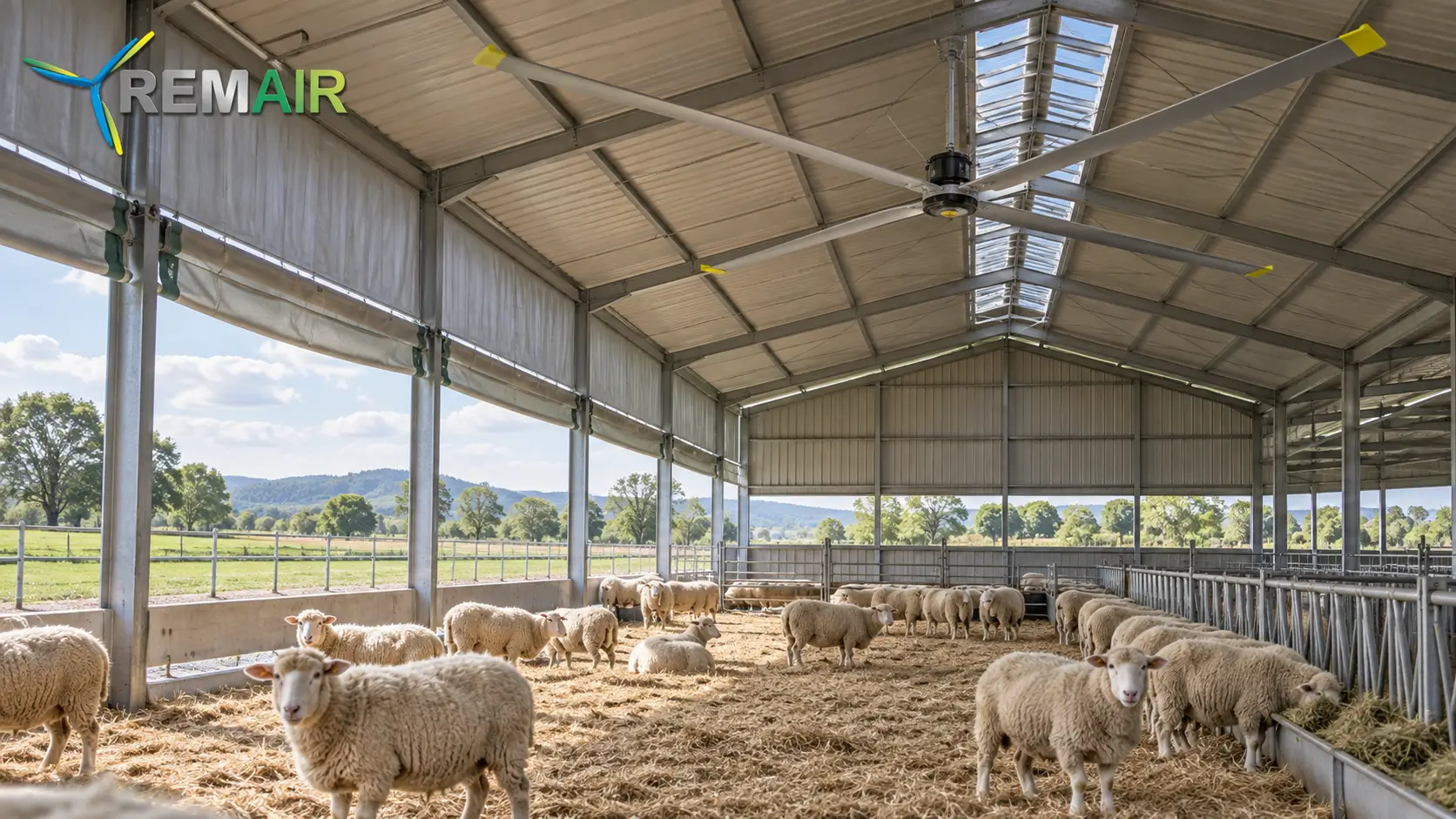
Natural ventilation works on the principle that warm air rises and wind creates pressure differences. Air enters through openings in the side walls and exits through an opening at the roof ridge. When correctly sized, it works without consuming energy.
Its limitation is that natural ventilation depends on outdoor conditions. On a windless summer noon, when the outside temperature is 33 °C and the air is still, the stack effect weakens and there is almost no air movement indoors. The system becomes ineffective precisely when the animals need airflow the most.
Mechanical ventilation fills this gap. Fans move air independently of outdoor conditions. The right approach is not to treat the two systems as alternatives, but as complementary: natural ventilation provides the basic air exchange, while fans operate during stagnant periods and hot weather. For a general comparison of ventilation methods, see our article on types of barn ventilation for details.
Ventilation Solutions by Barn Type
| Barn type | Main problem | Recommended solution |
|---|---|---|
| Open barn | Air exchange is generally sufficient, but stagnant air and heat accumulation under shade can occur on windless days | Circulation fan under the shade; windbreak curtain facing the prevailing wind in winter |
| Semi-open barn | Air remains stagnant in the enclosed section, creating dead-air pockets between the open and closed areas | Fan positioned to supply the enclosed section; adjustable side curtain |
| Closed barn | Moisture and ammonia accumulation; air exchange stops when doors are closed in winter | Ridge opening and adjustable side inlet; circulation fan operating year-round |
The common rule for all three types is that air inlets and outlets must be planned together. Air will not flow in a barn with only an exhaust opening; without an inlet, the outlet cannot function properly.
Summer Cooling: Fan Use and Correct Positioning
The aim of summer cooling is not to lower the temperature of the barn air — that is neither practical nor economical. The goal is to move air over the animal at sufficient speed to carry away body heat. At the same temperature, an environment with airflow feels noticeably cooler to the animal.
The target air speed at animal level is approximately 1–2 m/s. Below this range, the cooling effect remains limited.
Key positioning considerations:
- Resting areas are the first priority. Sheep spend a large part of the day lying down, so airflow must reach the resting area.
- Feed and water lines are the second priority. Keeping the area in front of the feed line cool helps prevent feed intake from falling in hot weather.
- Dead-air pockets must be identified. Air tends to stagnate in corners, along walls and between partitions; these are the areas where moisture and ammonia accumulate.
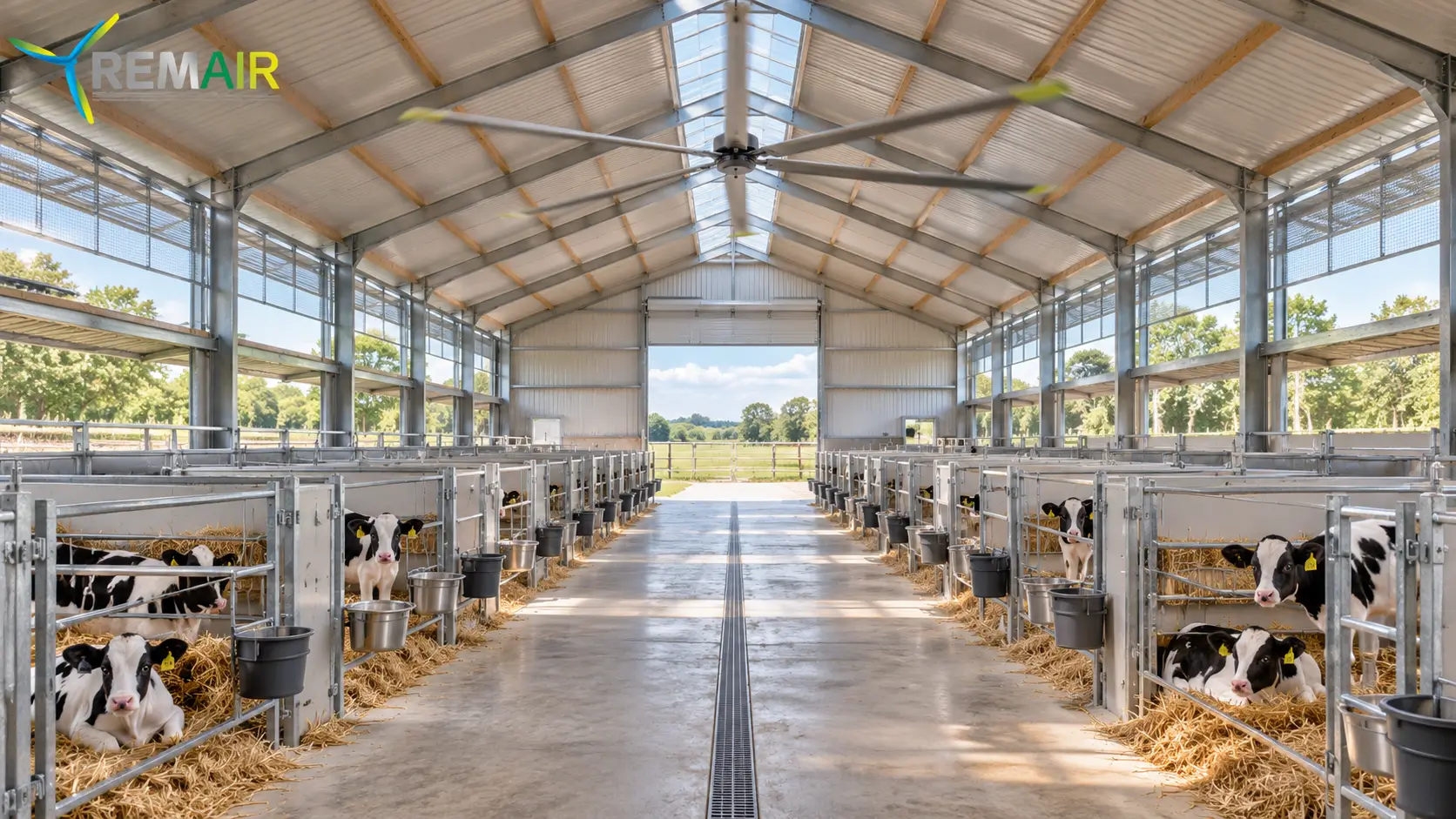
- Lambing pens require separate consideration. Newborn lambs must be protected from direct airflow.
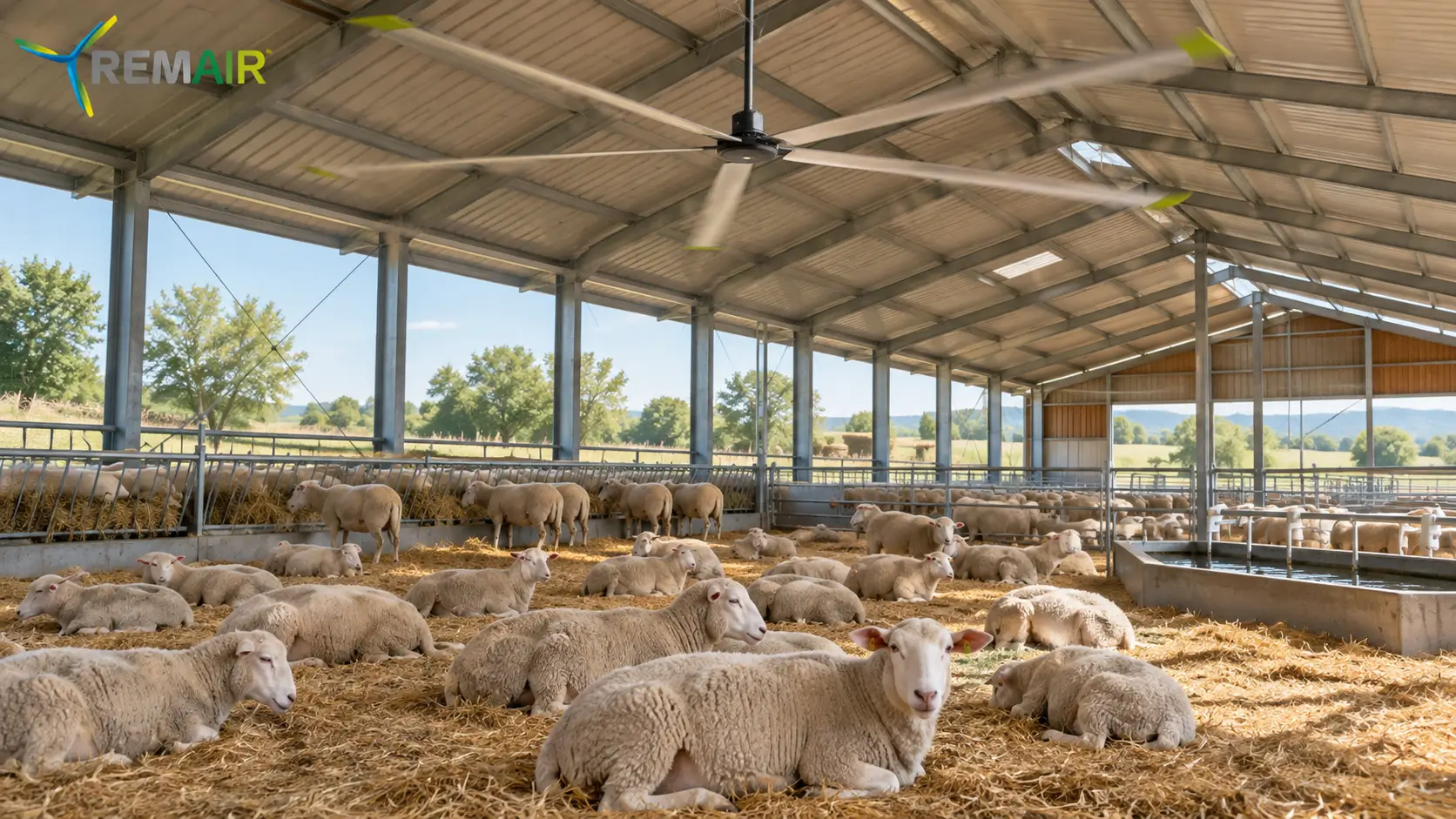
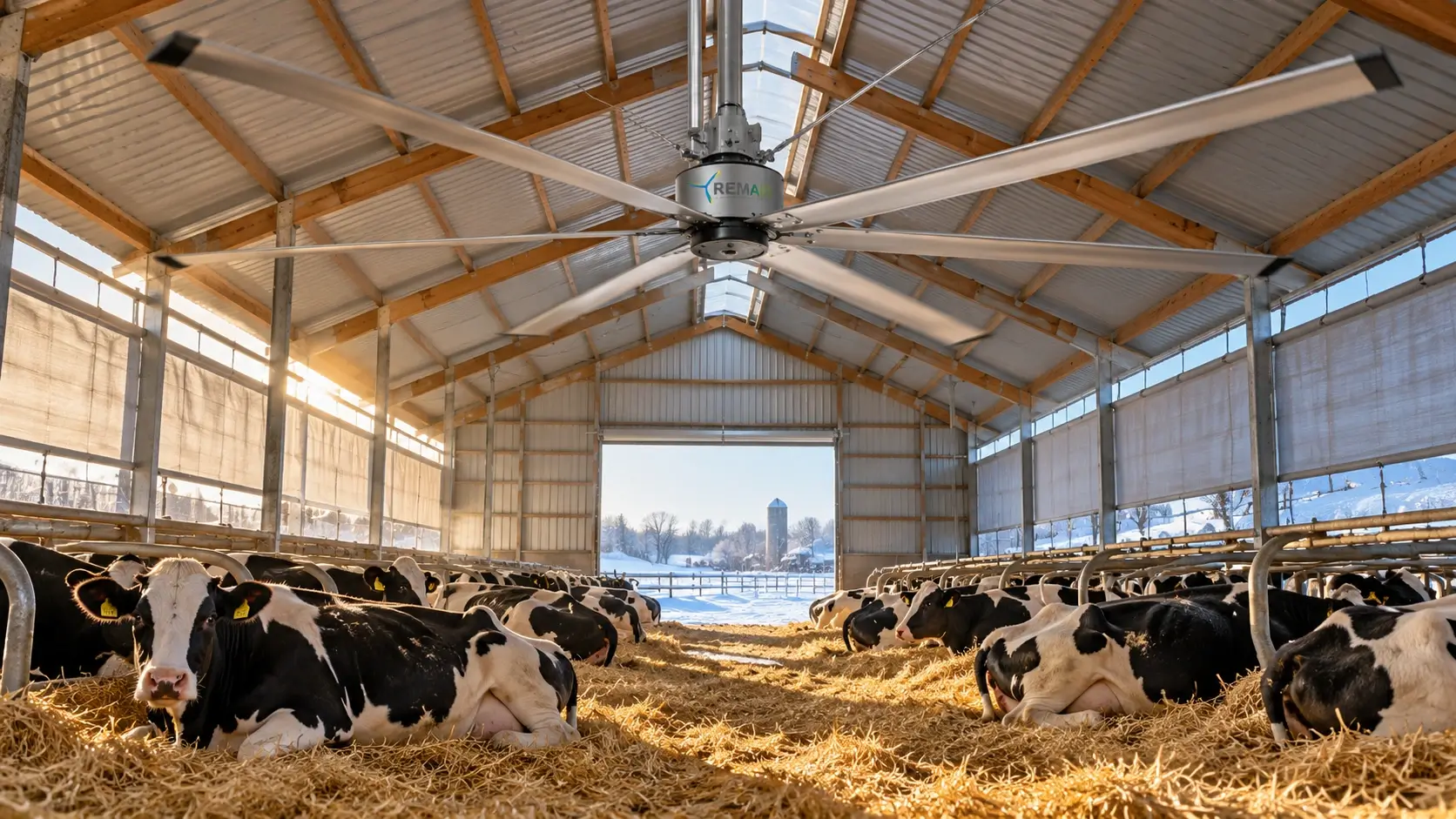
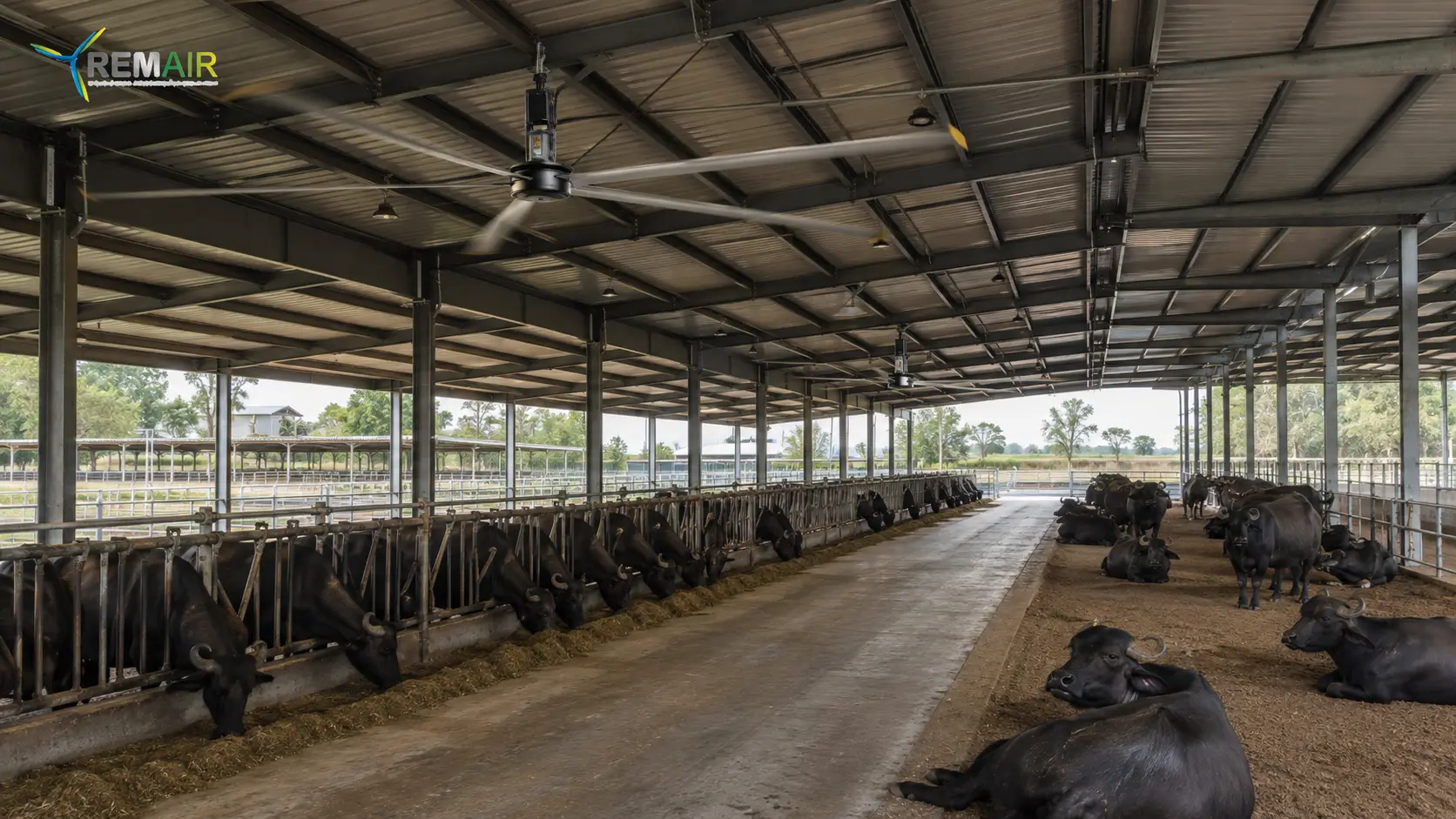
At this point, fan type becomes decisive. A large number of small-diameter fans produce a narrow, forceful jet of air with limited coverage; some animals remain in the airflow while others receive almost none. Large-diameter, low-speed HVLS ceiling fans push a broad column of air slowly downward and spread it across the floor, creating balanced airflow throughout the barn. Because they operate at low speed, noise levels are also low, which helps animals adapt to the system quickly.
Because Remair HVLS fans are available in 4, 5 and 6 meter diameter options, the fan size can be selected according to barn width. The number of fans required depends on the barn area, ceiling height and partition layout; we explain the calculation logic with an example in our article on how many HVLS fans are required for a 1000 m² area with a worked example.
Winter Ventilation Balance: Removing Moisture Without Drafts
The purpose of winter ventilation is not cooling, but removing moisture and ammonia. For this reason, the target air speed is completely different: airflow at animal level should not exceed 0.3 m/s. Higher speeds create a draft effect in cold weather and can trigger respiratory problems.
The practical approach is to keep air movement above the animals’ back level in winter. When a circulation fan runs at low speed in an upward direction, it mixes the warm air accumulated near the ceiling back down; this reduces ceiling condensation without creating a direct breeze over the animals. On fans with reverse operation, this mode is specifically intended for winter use.
Completely closing the barn in winter is one of the most common mistakes. In a barn sealed to retain heat, moisture and ammonia can reach levels that threaten animal health within 24 hours. Sheep tolerate cold; they do not tolerate damp, polluted air. For information on calculating required air exchange, see our article on air changes per hour (ACH) calculations as a practical guide.
For overall ventilation system planning in small-ruminant operations, including goat housing, see our article on ventilation systems for sheep and goat farming and for comparison with cattle housing, see how barn ventilation should be designed in our related articles.
Let’s Plan the Right Solution for Your Sheep Barn
Every sheep barn has a different cross-section, ceiling height, partition layout and prevailing wind direction. Even two barns with the same floor area may require different numbers and positions of fans. Proper planning starts with accurate measurements and layout information.
As Remair, a manufacturer of HVLS ceiling fans since 2019, we can determine the appropriate fan diameter, quantity and positioning together according to your barn dimensions and flock size. our HVLS fan models you can review our agriculture and livestock applications and, to share your project, contact you can reach us through our page.
Frequently Asked Questions About Sheep Barn Ventilation
Does shearing reduce heat stress?
Yes. Fleece acts as an insulating layer that makes it harder to release body heat, so shearing before hot weather begins can significantly improve heat dissipation. However, shearing alone is not enough; a shorn sheep still cannot cool effectively in stagnant air. Very short shearing can also increase the risk of sunburn, so shade is essential in open barns. The best results come from combining timely shearing with adequate airflow.
Do fans frighten sheep, and how long does adaptation take?
Some uneasiness may occur when fans are first started, but sheep usually adapt within a few days and soon begin choosing the cooler areas beneath the fans. To make adaptation easier, fans should initially be operated at low speed and switched on while the flock is outside the barn. The main cause of fear is not the airflow itself but sudden high noise and vibration. For this reason, large-diameter low-speed fans are generally accepted much more easily by animals than small high-speed fans.
How should ventilation be adjusted in lambing pens?
Newborn lambs cannot regulate body temperature as effectively as adults, so they should not be exposed to direct airflow. Lambing pens should be positioned away from barn air inlets and from points where fan airflow descends directly. However, these areas should not become unventilated, because moisture and ammonia can still accumulate. The correct balance is to maintain air exchange around the pen without creating a noticeable draft at lamb level. Curtains or partitions at pen height are a practical way to achieve this balance.
How much space is required per animal in a sheep barn?
In enclosed barns, approximately 1–1.5 m² should be provided for an adult sheep and 2–2.5 m² for a ewe with lambs. More space is generally required for rams and ewes in late pregnancy. Space is not only a comfort issue: as animal density increases, the amount of moisture, heat and ammonia produced per unit area also rises, directly increasing ventilation demand. In an overcrowded barn, the first step toward solving a ventilation problem is often to reduce stocking density.
How can ammonia levels be controlled in a sheep barn?
Control has three main elements: keeping bedding dry, renewing it regularly and maintaining continuous air exchange. Ammonia is lighter than air and tends to rise, but without air movement it can also accumulate at animal level. A practical warning sign is burning eyes and a sharp odor when entering the barn; at that point the level is already high from an animal-health perspective. Simple ammonia detection tubes or gas meters can be used for accurate measurement. Measurements should be taken at animal level, approximately half a meter above the floor.
How much electricity does a sheep-barn fan consume?
Consumption depends on fan diameter, motor power and operating speed. Because HVLS fans move large volumes of air at low speed, they consume significantly less energy than the number of small high-speed fans needed to cover the same area. In addition, because these fans are operated intermittently during summer days and at low speed in winter, annual consumption is often lower than expected. For calculation methods and sample values, see our article on how much electricity a ventilation fan consumes for details.

Leave a Comment