
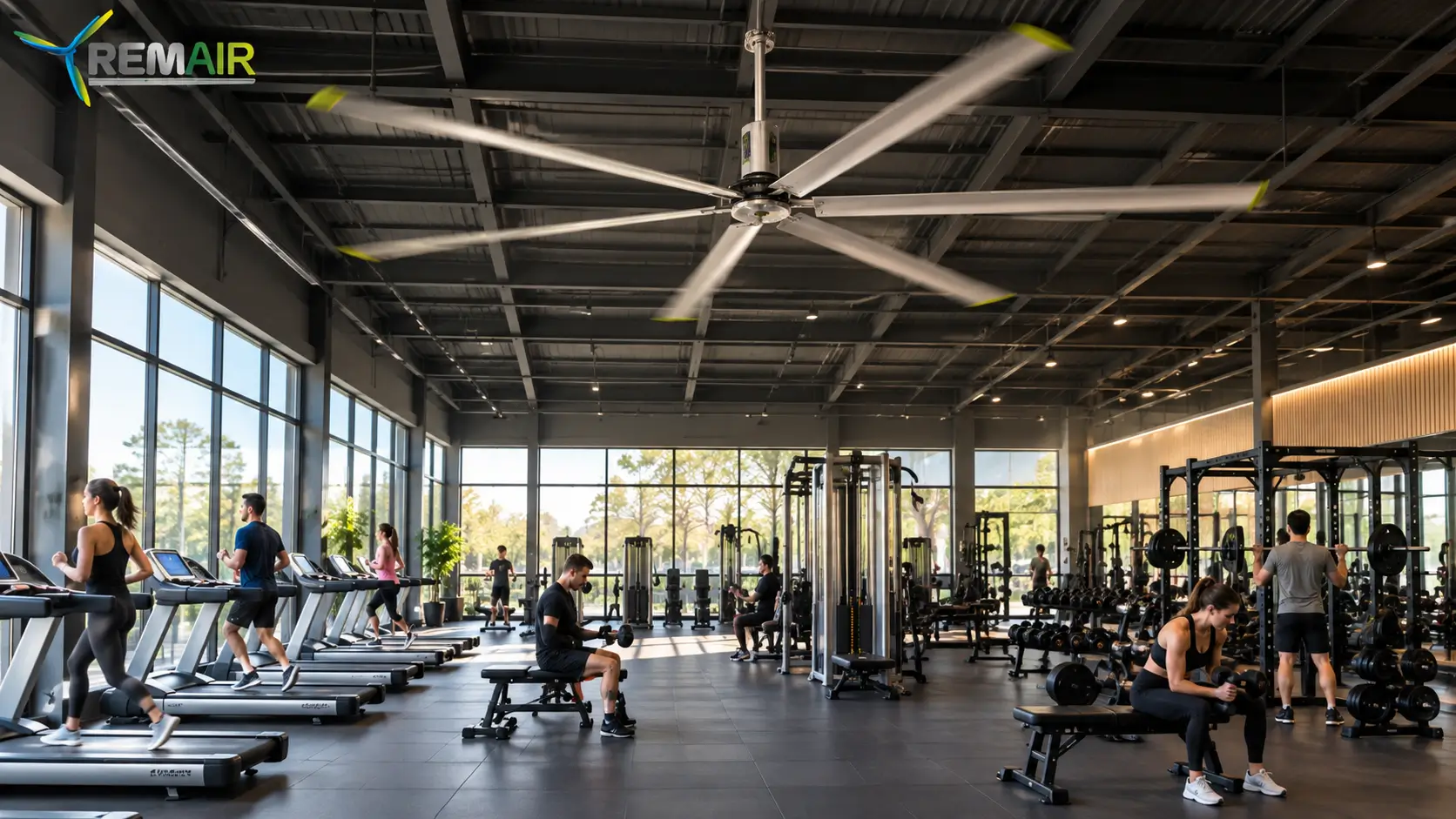

Choosing the right HVLS fan for a gym depends on three measurements: floor area, ceiling height, and the column-stand layout. The general approach is to use a small number of large-diameter, low-speed fans instead of many small, high-speed fans. A 4-metre diameter is a suitable starting point for gyms of 400-600 m², 5 metres for 600-900 m², and 6 metres for spaces above 900 m². If the ceiling height is below 4 metres, the diameter should be reduced and the number of fans increased.
A gym is different from a factory or warehouse in terms of ventilation. The heat load is high — every exercising athlete generates a considerable amount of heat and moisture — while the environment must also provide quiet, unobtrusive airflow. A fan that constantly hums during a workout quickly becomes one of the first complaints from members. Below, we examine selection criteria by gym type, installation rules, and operating costs in a way that can directly support a purchasing decision.
Air Quality and Humidity Problems in Gyms
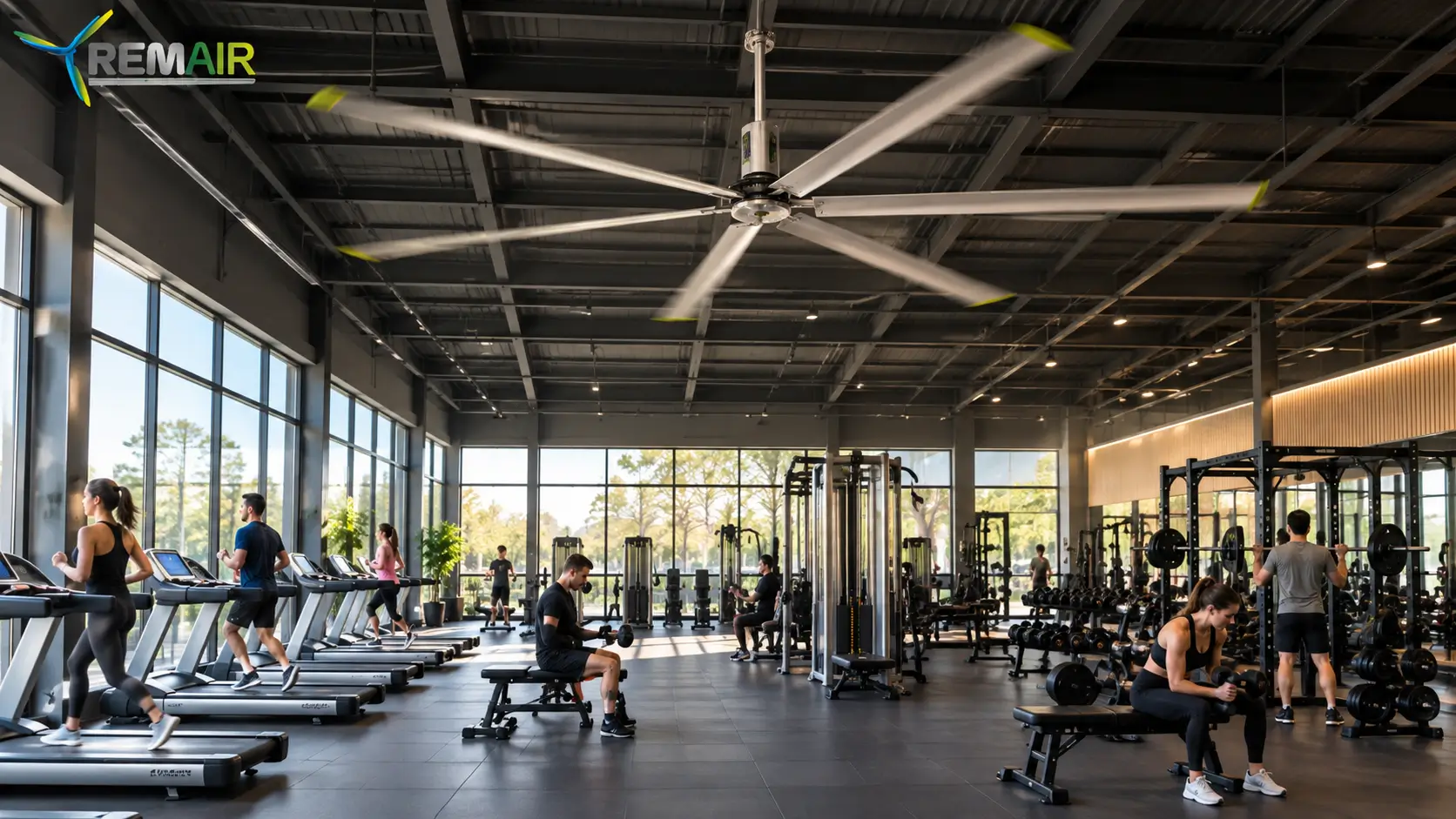
A person exercising produces many times more heat and water vapour than at rest. During an intensive group class or in a crowded weight-training area, this load builds up quickly and leads to two consequences.
The first is humidity. As relative humidity rises, sweat evaporates more slowly; the body cannot cool effectively, and the athlete feels much more uncomfortable at the same temperature. Indoor relative humidity should ideally be kept within the 40-60% range. Humidity can also cause condensation on equipment, slippery floors, and long-term mould and odour problems.
The second is stagnant air and odour build-up. Even in gyms equipped with air conditioning or split systems, air can remain stagnant in certain areas; while the area in front of the unit is cool, corners and the space below the ceiling remain warm. The main cause of odour is often not inadequate cleaning, but a lack of air movement.
The common solution to both problems is air circulation. We discussed the health and comfort aspects in detail in our article on improving air quality and cooling in gyms.
Why One Large HVLS Fan Instead of Many Small Fans?
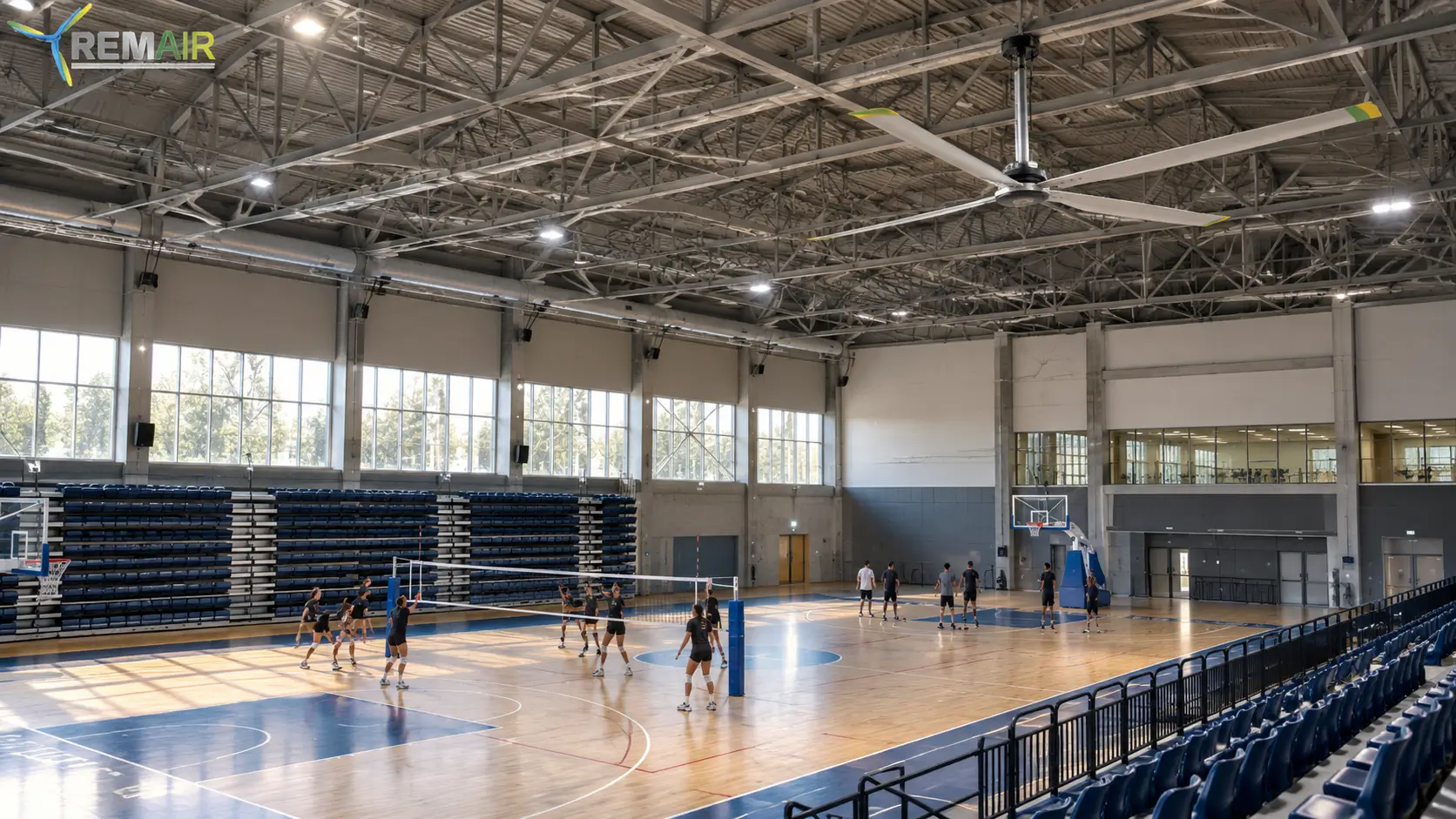
There are two ways to cool the same area: a few large-diameter, slow fans or dozens of small, high-speed fans. Although they may achieve similar airflow rates on paper, the results inside the gym are completely different.
| Comparison | HVLS fan (large diameter, low speed) | Small-diameter, high-speed fans |
|---|---|---|
| Airflow pattern | A broad column of air descends to the floor and spreads horizontally | Narrow, forceful air jet with limited coverage |
| Coverage | Balanced airflow throughout the gym | Strong airflow in front of the fan, stagnant zones in between |
| Noise | Quiet operation due to low speed | Total noise increases as the number of units increases |
| Energy | One motor, low speed, low consumption | High combined consumption from multiple motors |
| Maintenance | Fewer service points, planned maintenance | Each unit is a separate maintenance and failure point |
In a gym, the decisive row is coverage. In a system built with small fans, a member on the treadmill may be uncomfortable because of the direct draft while the free-weight area ten metres away receives almost no airflow. An HVLS fan, by contrast, creates balanced airflow that is not perceived as a harsh draft at human level but whose cooling effect is clearly felt.
Selecting Fan Diameter by Gym Floor Area
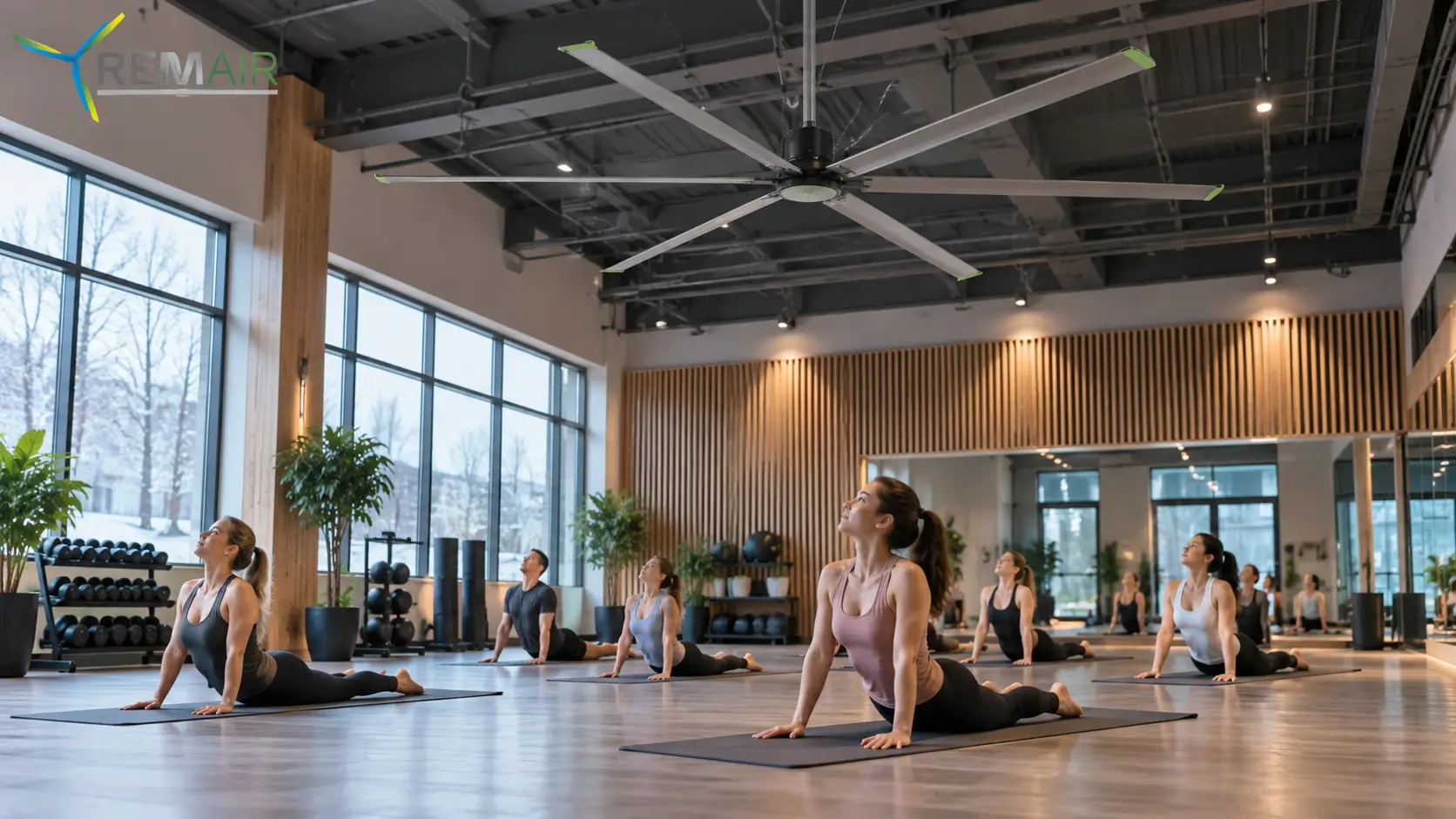
Floor area is the starting point for selecting diameter, but area alone is not enough; ceiling height and how divided the gym is will change the result.
| Fan diameter | Approximate planning area | Suitable ceiling height | Typical facility |
|---|---|---|---|
| 4 metres | 400 – 600 m² | 4 – 6 m | Boutique fitness gym, group-class studio, martial arts gym |
| 5 metres | 600 – 900 m² | 5 – 8 m | Medium-sized fitness centre, tennis and squash court |
| 6 metres | 900 m² and above | 6 m and above | Indoor sports complex, basketball-volleyball hall, indoor football pitch |
The values in the table apply to open-plan, unobstructed gyms. If the space is divided by columns or includes a suspended ceiling or stands, coverage decreases and the number of fans increases. In a divided gym, two medium-diameter fans often produce better results than one large fan. We explain how to calculate the required quantity with an example in our article on how many HVLS fans are required for a 1000 m² area.
The number of blades is also part of the selection. As blade count increases, the volume of air moved increases; with fewer blades, operation becomes quieter. For this reason, five-blade models are often preferred in gyms because they offer the best balance between airflow and noise.
Ceiling Height and Installation Rules
Three measurements are critical during installation:
- Distance between the blade plane and the ceiling. There must be sufficient clearance above the blades so the fan can draw air freely. If the fan is suspended too close to the ceiling, intake is restricted and efficiency falls.
- Height of the blade plane above the floor. For safety and comfort, this distance should be at least 3.5 metres. In halls used for ball sports such as volleyball or basketball, the playing height must also be taken into account.
- Distance from walls and obstacles. Once the air produced by the fan reaches the floor, it spreads horizontally; if the fan is positioned too close to a wall, part of the airflow is wasted.
Large-diameter fans are not appropriate in gyms with ceilings below 4 metres; in such cases, a greater number of smaller-diameter fans should be used. The first installation step is also to connect the suspension point to the load-bearing structure and confirm its structural suitability.
Why Is Noise Level Critical?
In a gym, noise has a direct impact on member satisfaction. Music, equipment noise, and conversation already create a certain background level; adding the constant hum of a fan can make the environment tiring. In group-class studios, the instructor must be clearly heard, while in yoga and Pilates areas maintaining quiet is directly related to service quality.
The advantage of HVLS fans here is physical: because they produce the same airflow at low rotational speed, blade-tip speed and therefore aerodynamic noise remain low. Measurements on Remair HVLS fans recorded a sound level of 51 dB, which is comparable to the background noise level of a normal office environment.
Energy Consumption and Operating Cost
The figure that matters in a purchasing decision is not only the equipment price but the annual operating cost. In a gym, fans run for long hours each day throughout the season, so motor efficiency and speed range are more decisive than the purchase price itself.
Because HVLS fans move large volumes of air at low speed, they consume significantly less energy than a group of small fans required to cover the same area. The second benefit comes from air conditioning: as air movement lowers perceived temperature, the air-conditioning set point can be raised by a few degrees, directly reducing the cooling load. We compare whether an HVLS fan is an alternative or a complement to air conditioning in our article on the differences between HVLS fans and air conditioning; for the method used to calculate consumption, see our article on how much electricity a ventilation fan consumes.
Breaking Up Heat Stratification in Winter
A common winter condition in high-ceiling gyms is warm air near the ceiling and cold air at floor level. Heated air rises and accumulates overhead; even if the heating system continues to run, the temperature at athlete level may not reach the desired value.
When an HVLS fan is operated at low speed in winter, it breaks up this stratification. It gently mixes the warm air accumulated near the ceiling downward, reducing temperature differences across the gym. The result is twofold: comfort improves at floor level and the heating system runs less. This use, known as destratification, is the key reason an HVLS fan is not merely a summer investment.
Let Us Determine the Right Model for Your Gym
In summary, the decision depends on four questions: what is the gym’s net floor area, how high is the ceiling, is the space divided by columns or stands, and in which areas is quiet operation a priority? These four answers determine the diameter, quantity, and placement together.
Remair HVLS fans are available in 4, 5, and 6 metre diameters with 4, 5, and 6 blade options, allowing the model to be matched to gym dimensions and noise sensitivity. our HVLS fan modelsYou can review our gym applications, and contact us through our contact page with your gym dimensions to receive a project-specific recommendation.
Frequently Asked Questions About Choosing HVLS Fans for Gyms
Does an HVLS fan affect the trajectory of a basketball or volleyball?
When operated at the correct height and speed, it does not create enough deflection to affect play because HVLS fans produce a broad, slow column of air rather than a hard jet. Even so, two precautions are taken in competition halls: fans are positioned along the sides of the court or the stand axis rather than directly over the playing area, and speed control allows the fan to be slowed or temporarily stopped during matches. This level of sensitivity is generally unnecessary in training halls.
Do fan blades create flickering shadows in the lighting?
If luminaires are positioned directly above the fan blades, the rotating blades can interrupt the light and create a stroboscopic shadow effect. This is more noticeable with high-speed fans; because HVLS fans rotate slowly, the effect is much weaker. Even so, the lighting layout and fan axes should be designed so they do not overlap. In existing gyms, the solution is to move luminaires away from the fan axes or redesign the lighting to provide more diffuse illumination.
Can an HVLS fan be retrofitted to an operating gym?
Yes. The key factor is whether the ceiling’s load-bearing structure can withstand the fan load and rotational torque; installation is straightforward in gyms with steel trusses, beams, or a suitable purlin line. In spaces with suspended ceilings, the fan is attached to the structural element above, not to the suspended ceiling itself. Because no structural changes are usually required beyond routing power and control lines, installation can generally be completed during a short period when the gym is closed.
How often should an HVLS fan be maintained?
A planned inspection once a year is sufficient for most gyms. The inspection should check the torque of blade connection bolts, the condition of suspension and safety components, gearbox bearing noise, and dust accumulation on blade surfaces. Dust is not merely a cosmetic issue; a layer on the blades can reduce aerodynamic efficiency and create imbalance. In gyms with high airborne dust loads, the interval should be shortened to six months.
Can an HVLS fan be used together with evaporative cooling or misting systems?
Yes, and the systems generally complement each other; the fan distributes cooled air throughout the gym and increases the system’s effect. However, one point requires care in gyms: evaporative systems add moisture to the air, while the space already carries a high humidity load from athletes. When relative humidity rises above 60%, sweat evaporates more slowly and the cooling sensation decreases. For this reason, air circulation and humidity control should take priority over misting in enclosed gyms.
Can HVLS fans be used in facilities with swimming pools?
Yes. Air movement is particularly valuable for humidity management in pool halls because condensation can accumulate on ceilings and walls when air is stagnant. However, two conditions are essential in these environments: materials and surface protection must withstand high relative humidity and the corrosive effects of chlorine compounds. A standard gym fan may corrode earlier than expected in a pool atmosphere, so fan selection for pool facilities should be evaluated on a project-specific basis.

Leave a Comment