
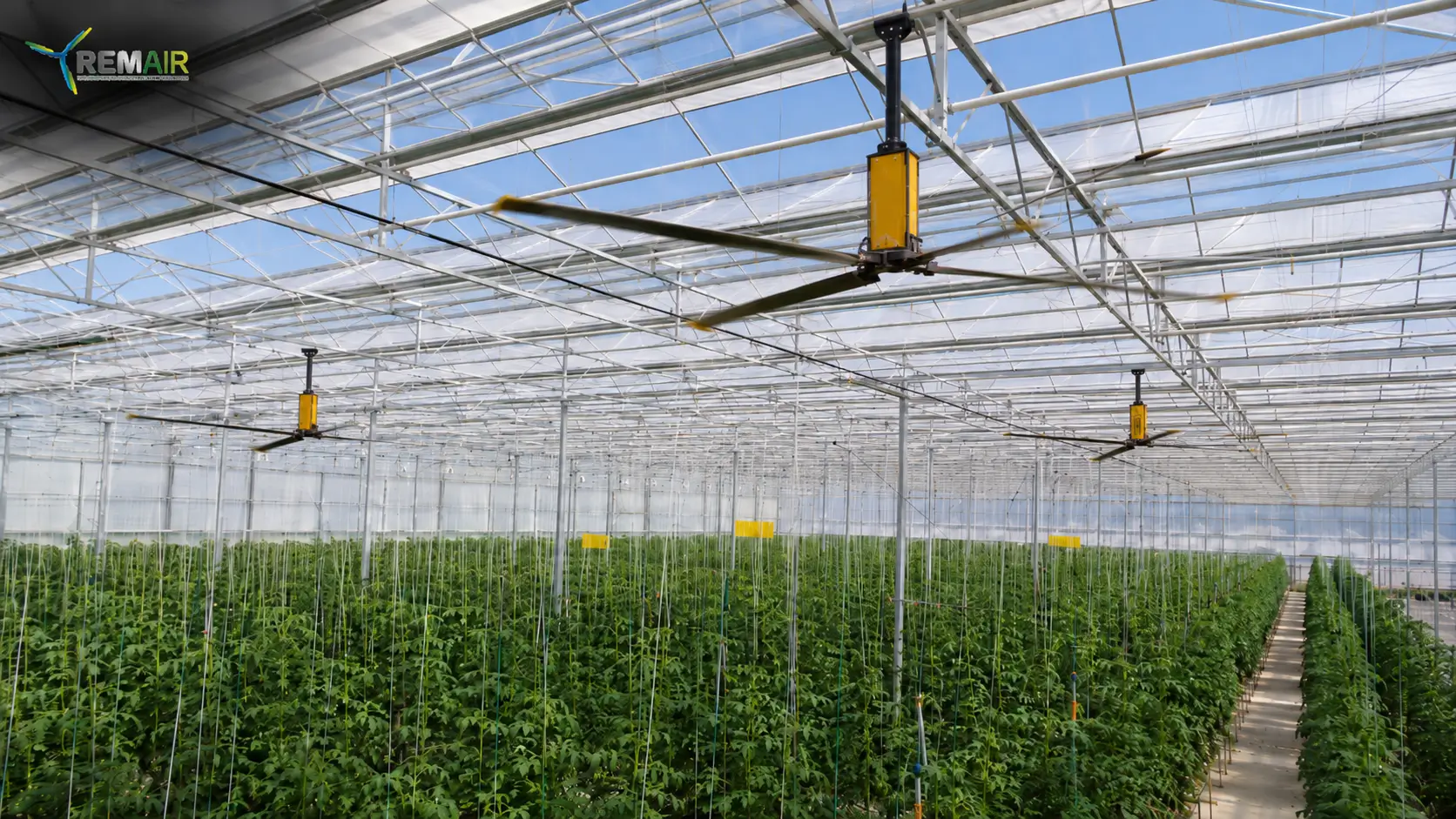
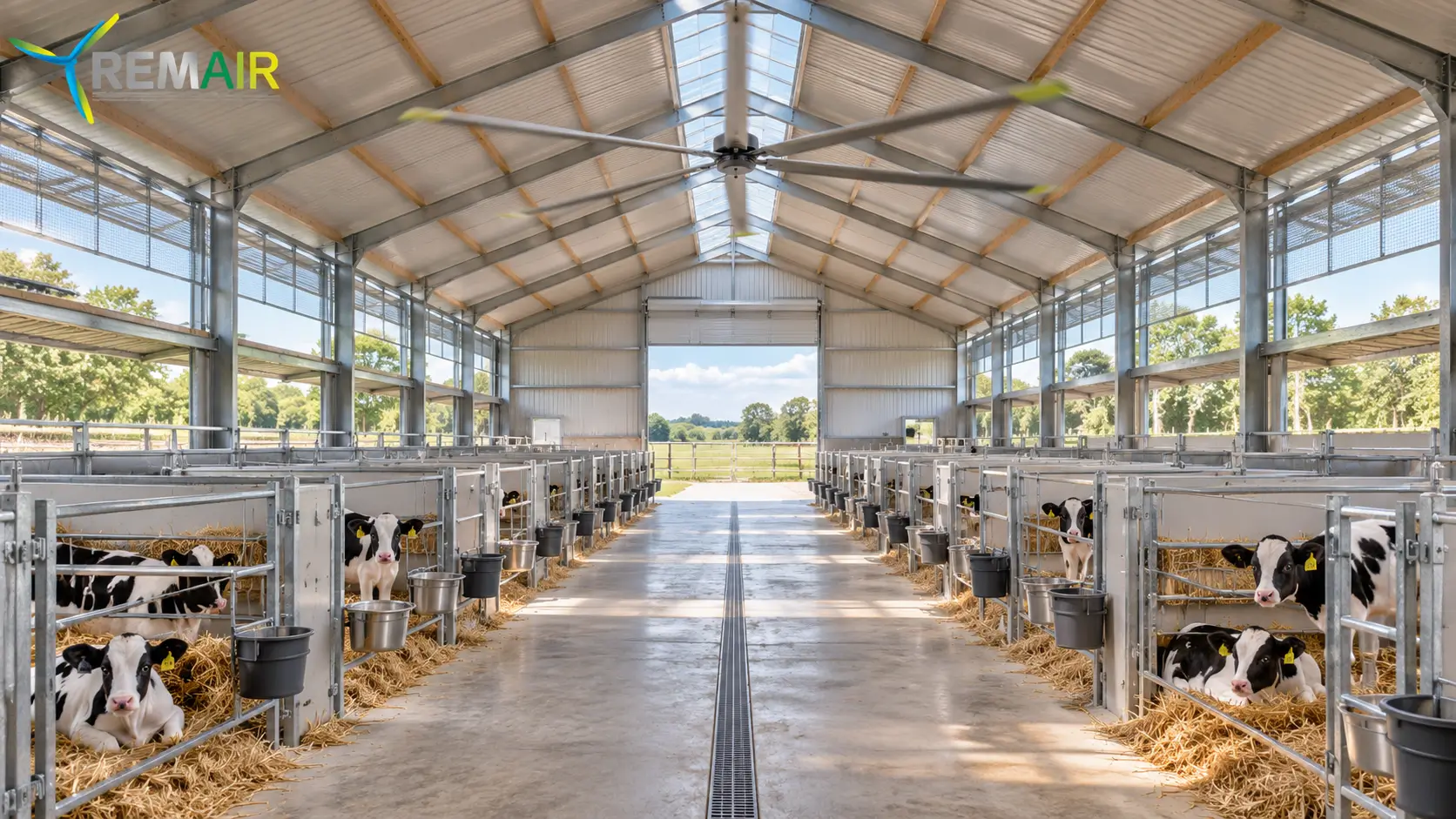
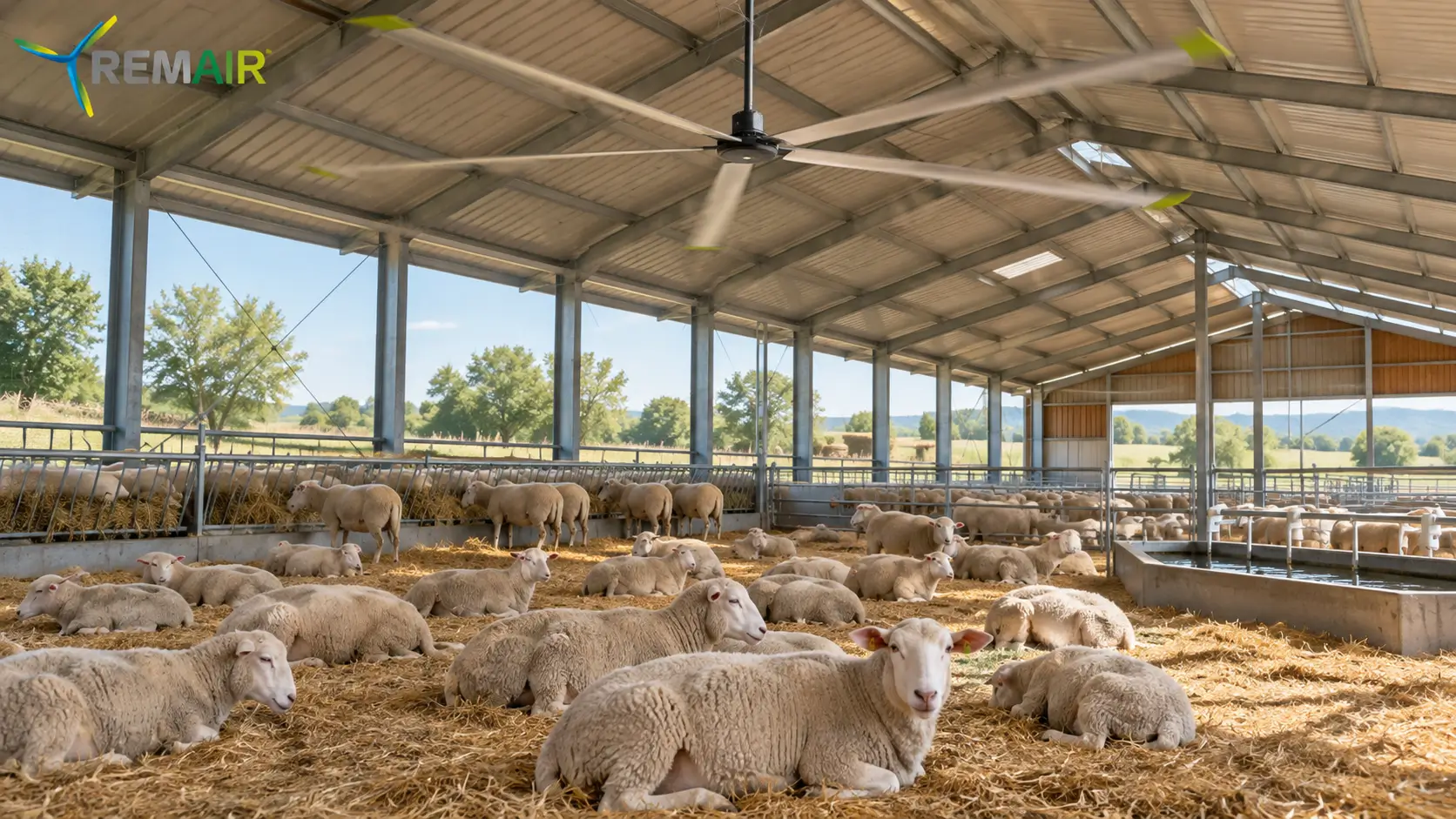
A greenhouse circulation fan is equipment that keeps the air beneath the enclosed cover continuously moving, ensuring that temperature and humidity remain balanced at every point. It operates independently of heaters or ventilation windows; its purpose is not to heat or cool the air, but to move the existing air down to plant level. When the air in a closed greenhouse is left undisturbed, it stratifies: warm air rises to the roof while a cool and humid zone forms near the floor. A circulation fan is used precisely to break up this stratification.
In practice, there are two main approaches. In small and medium-sized greenhouses, small-diameter horizontal airflow fans installed below the roof are used, while in wide-span modern greenhouses, low-speed large-diameter HVLS fans are preferred. In recent years, the second group has become increasingly prominent among growers because it moves the same volume of air using much less electricity. Below, we explain step by step what a circulation fan does in a greenhouse, how it is selected, and how it should be positioned.
Let's Determine the Right Circulation Fan for Your Greenhouse Together
Contact the Remair Fan engineering team for a fan capacity and layout plan suited to your greenhouse dimensions, height, and crop pattern.
Why Does Air Become Stagnant Inside a Greenhouse?
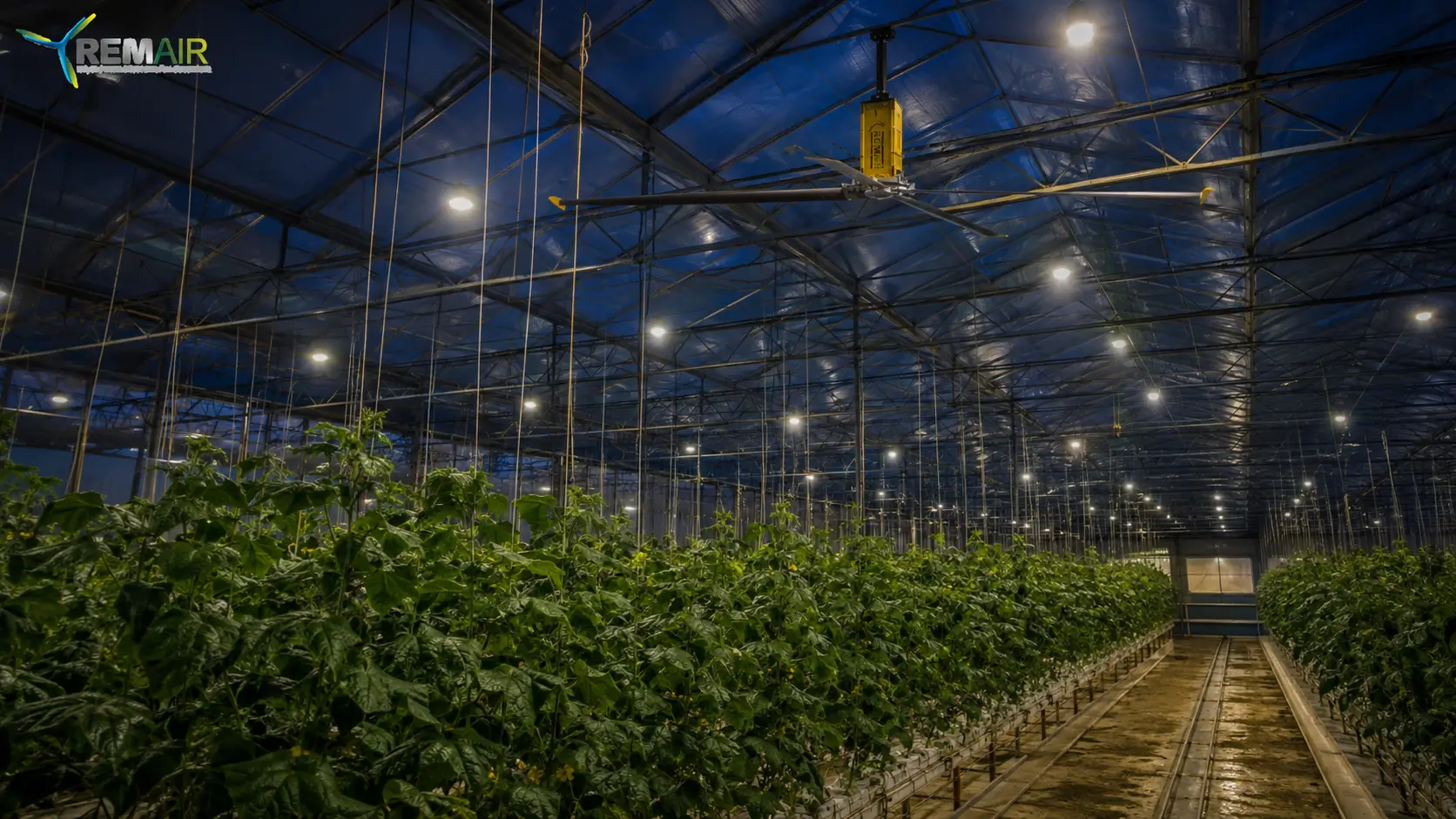
The greenhouse cover protects the plant by blocking outside wind. This protection also creates a disadvantage: there is no longer a natural force inside to initiate airflow. When sunlight passes through the cover and warms the ground, the heated air rises and accumulates near the roof. The area close to the ground remains relatively cool. The difference can reach 5 to 8 degrees, especially in high-roof greenhouses.
The second consequence of this stratification appears at the leaf surface. Where the air remains still, a thin stagnant boundary layer forms immediately above the leaf. Because the plant continues to transpire, humidity in this layer rises rapidly. Once the leaf can no longer release water vapor into the saturated air around it, transpiration slows, and the uptake of calcium and other nutrients transported from the roots also decreases.
Nighttime is more critical. When the sun goes down, the cover surface cools rapidly, and condensation begins when the warm, humid air inside contacts this cold surface. When dripping water falls directly onto leaves and fruit, it creates ideal conditions for disease. When the air is kept moving continuously, the temperature difference decreases and condensation remains much more limited.
Benefits of Circulation Fans for the Greenhouse Climate
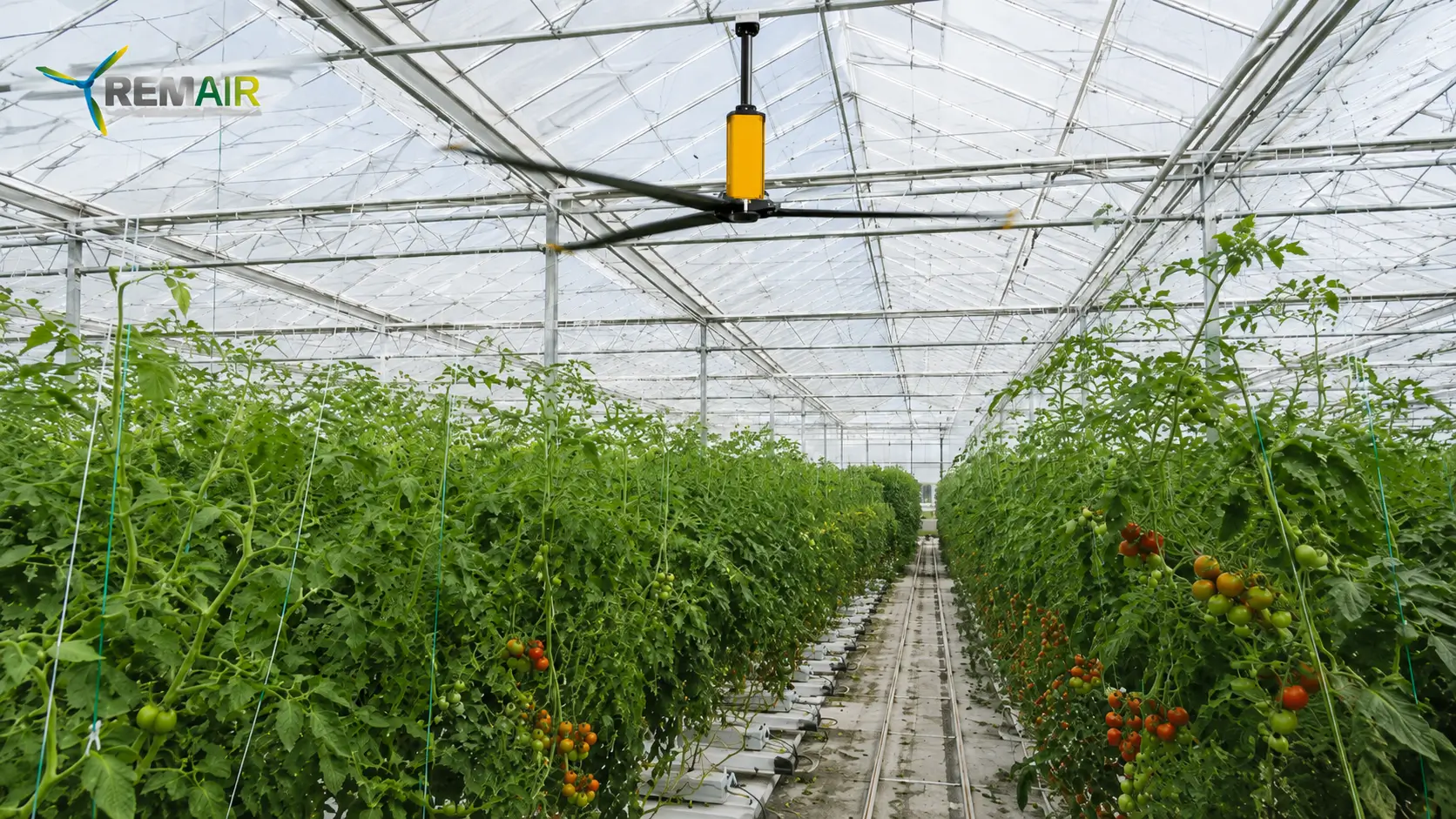
The fan's effect is not limited to a single area. Nearly all physical conditions inside the greenhouse are directly related to air movement:
- Temperature balance: Warm air accumulated at the roof is brought downward, creating a more uniform temperature throughout the greenhouse. During heating periods, this translates directly into fuel savings.
- Humidity distribution: The stagnant layer at the leaf surface is continuously renewed, eliminating localized humidity buildup.
- Reduced condensation: Droplet formation beneath the cover decreases significantly, reducing stains and burns caused by dripping.
- Carbon dioxide circulation: Carbon dioxide consumed by the plant decreases around the leaves. Air movement continuously carries fresh carbon dioxide to the leaf surface, helping maintain the photosynthesis rate.
- Uniform growth: The growth difference between plants at one end of the greenhouse and those at the other decreases, resulting in a more synchronized harvest.
- Spraying efficiency: Sprayed solution droplets are distributed more evenly and also reach the lower leaves of the plant.
Most of these benefits can be observed during the first season. In particular, the difference in heating costs is a major factor that shortens the payback period of the investment.
The Relationship Between Humidity Control and Plant Diseases
A significant proportion of fungal diseases encountered in greenhouse production are related to humidity. Pathogens such as powdery mildew, gray mold, and downy mildew spread when leaf surfaces remain wet for extended periods. The most practical way to shorten leaf-wetness duration is to keep the air moving.
In a greenhouse with circulation fans running, water on the leaf surface evaporates much faster than in a greenhouse with stagnant air. This difference interrupts the time required for disease organisms to germinate. In practice, many growers report that they can reduce spraying frequency after installing fans.
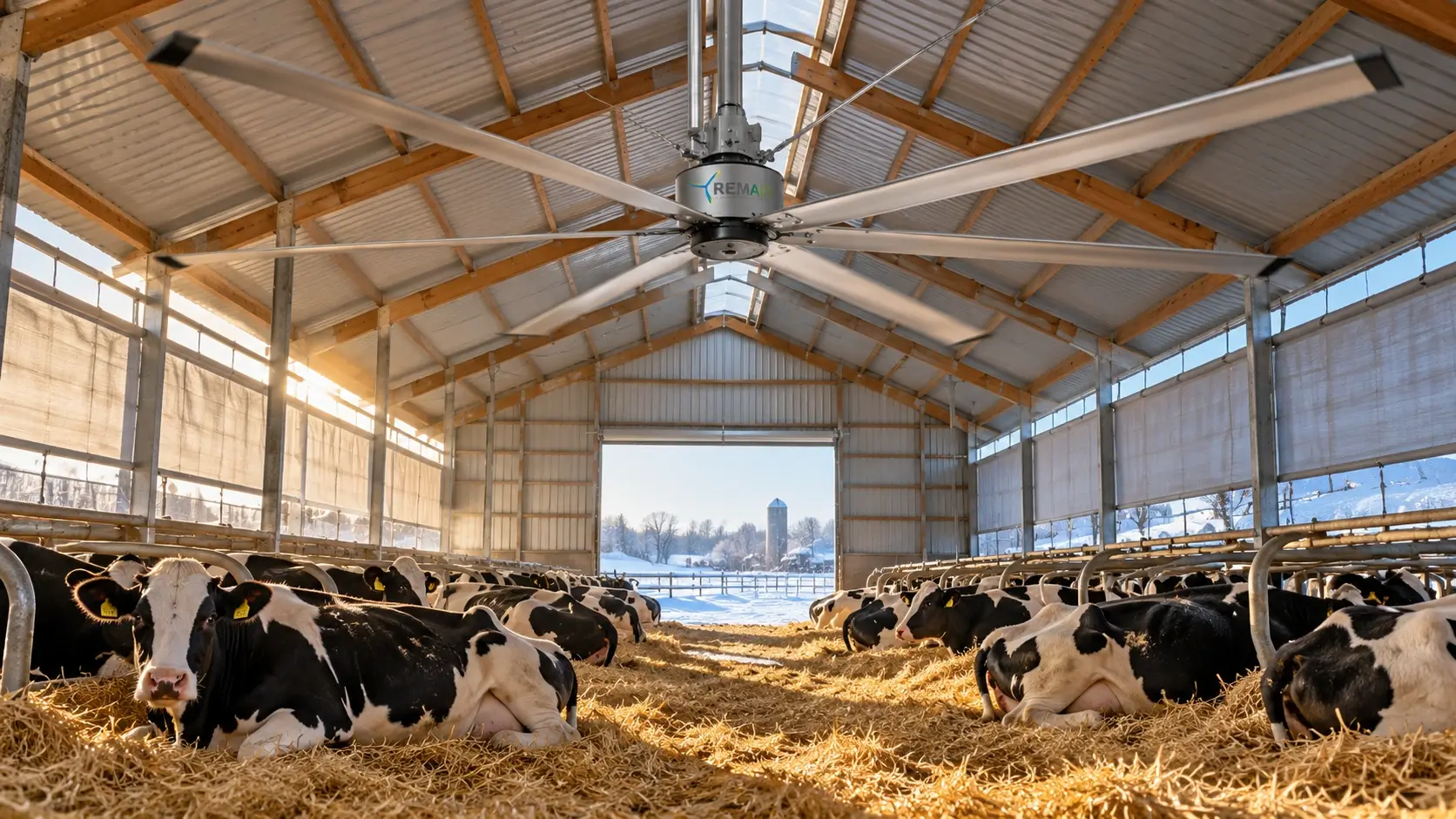
Humidity also has a ground-level aspect. Moisture that accumulates on the floor after irrigation can remain there for hours when there is no air movement, creating conditions for crown and root rot. The downward airflow created by the fan also dries this zone. The same principle applies in enclosed livestock buildings; if you would like to examine the subject in more detail, our article on sweating and humidity problems in barns explains the same principle through a different type of structure.
Fan Selection According to Greenhouse Type and Size
The first value considered when selecting a fan is airflow capacity, meaning the volume of air the fan moves per unit of time. A general rule is to circulate at least twice the greenhouse volume per hour. In a 1,000-square-meter greenhouse with an average height of 4 meters, the volume is 4,000 cubic meters; in this case, total fan capacity should not fall below 8,000 cubic meters per hour.
The second criterion is ceiling height. In low tunnel-type greenhouses, small-diameter high-speed horizontal airflow fans are sufficient. In contrast, large-diameter low-speed fans are much more effective in glass or polycarbonate greenhouses with heights of 4 meters or more. These fans gently push a broad column of air downward, creating movement without subjecting plants to wind stress. You can compare product groups and technical specifications on our HVLS fan models page.
The third criterion is air speed. A target of 0.3 to 0.7 meters per second is recommended at plant level. Airflow below this range cannot break stratification, while airflow above it may cause mechanical leaf damage and excessive transpiration. The right fan is not the one that produces the highest speed, but the one that produces balanced airflow over a wide area.
For the calculation method, see our article on ventilation fan electricity consumption for practical examples.
How Should Fan Placement Be Planned Correctly?
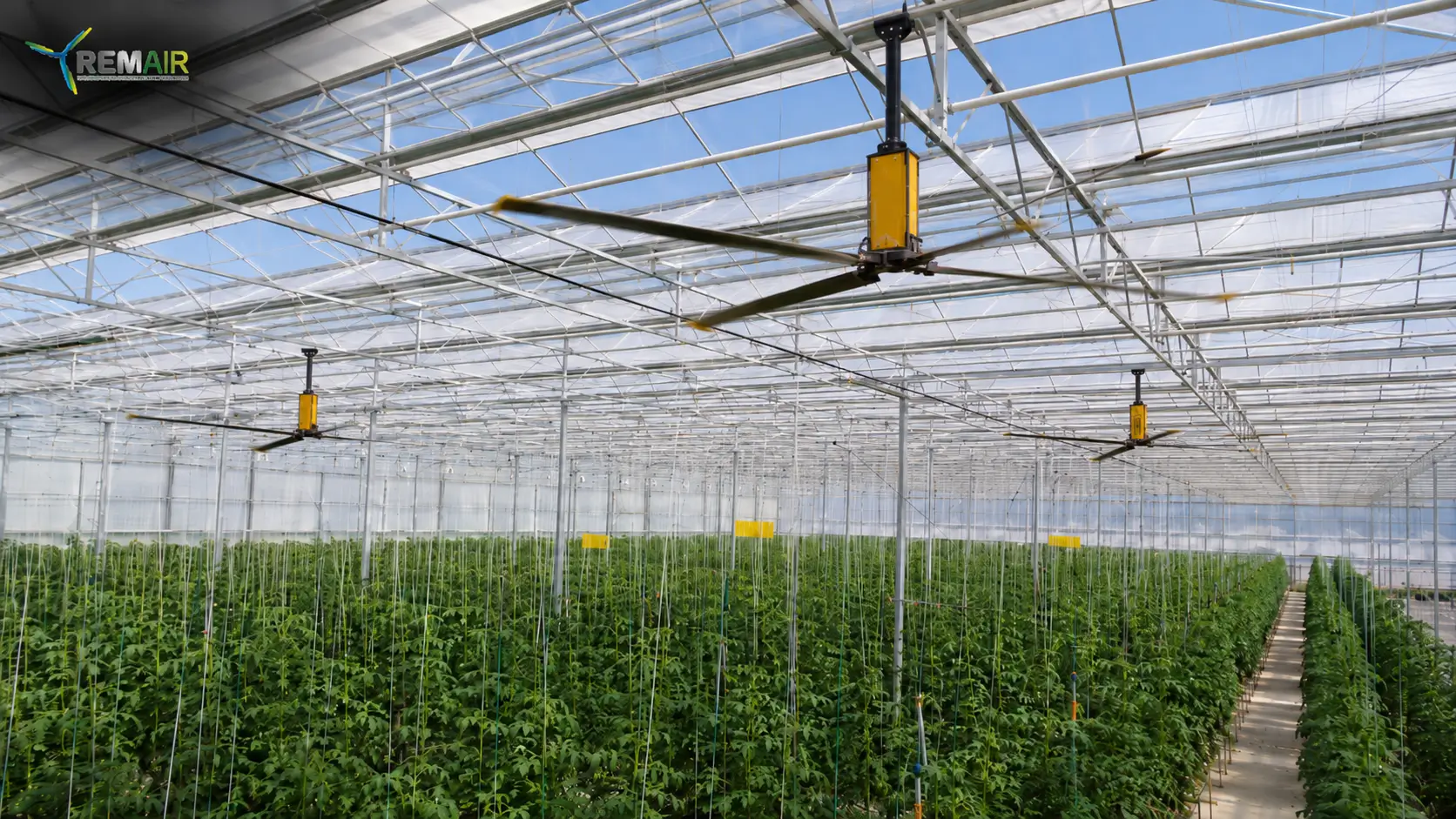
The primary goal in layout planning is to create a closed air circulation loop inside the greenhouse. Air is pushed from one end, reaches the opposite wall, and returns to the starting point along the side or roof. If this loop is not completed, part of the greenhouse remains stagnant and the problem is only partially solved.
With horizontal airflow fans, the distance between two fans is generally kept at 10 to 15 times the fan diameter. Fans are installed parallel to the crop rows along the same line and all face the same direction. Fans facing each other disrupt one another's airflow, so opposing placement should be avoided.
For a practical example of how many fans are needed, see How many HVLS fans are needed for a 1000 m² area? for details.
Mounting height is often overlooked. When a fan is suspended too close to the plants, it creates a strong airflow in a narrow area directly below it while leaving dead zones around it. When mounted high enough, the airflow expands as it moves downward and covers a wider area more evenly.
Difference Between Summer and Winter Use
In summer, the priority of the circulation fan is to create a cooling effect. Moving air accelerates evaporation from leaf surfaces and workers' skin, reducing the perceived temperature by several degrees. During this period, fans are generally operated at higher speed together with window ventilation.
In winter, the objective changes completely. The goal is no longer cooling, but bringing the heat accumulated near the roof back down. Much of the warm air produced by the heater rises directly to the roof and escapes through the covering. When the fan returns this air to plant level, the heater runs for a shorter time. For this reason, fans are operated at low speed but continuously during winter.
During transitional seasons, the main problem is nighttime condensation. On days with warm daytime temperatures and cool nights, heavy droplet formation occurs beneath the cover. Keeping fans running at low speed throughout the night largely eliminates this problem. Variable-speed models make it possible to manage all three scenarios with a single system.
Pre-Installation Checklist
There are several points that should be clarified before placing an order:
- Greenhouse enclosed area, ceiling height, and roof shape
- Crop type, plant height, and row spacing
- Capacity of the existing heating and ventilation system
- Load capacity of the electrical infrastructure and control panel location
- Load-bearing capacity of the roof structure for the fan weight
- Target temperature and humidity ranges throughout the season
- Fans must be accessible for maintenance and cleaning
Once this information is clear, the fan type, quantity, and placement can be calculated without relying on guesswork. Maintenance is quite simple: dust and agricultural residues on the blade surfaces are cleaned twice per season, while motor connection points and suspension components are visually inspected. Direct-drive models have no belts or pulleys, further reducing the maintenance burden.
In short, a circulation fan is not merely a comfort device in a greenhouse; it is a production tool that directly affects yield. When selected at the correct capacity and positioned properly, it simultaneously reduces temperature differences, humidity buildup, and disease pressure. For a solution suitable for your greenhouse, use our Remair Fan contact page to contact our team.
Frequently Asked Questions About Using Circulation Fans in Greenhouses
What does a circulation fan do in a greenhouse? Does it heat or cool the air?
A circulation fan does not directly heat or cool the air. It operates independently of heaters and ventilation windows; its main purpose is to break up air stratification inside the greenhouse and bring warm air accumulated near the roof down to plant level, creating a more uniform temperature and humidity balance throughout the area.
What problems occur when air remains stagnant inside a greenhouse?
In stagnant air, heat accumulates near the roof while the ground remains cool and humid. The humid, saturated air layer that forms at the leaf surface slows transpiration and calcium uptake from the roots. At night, condensation on the cooling cover can drip onto leaves, creating favorable conditions for fungal diseases such as powdery mildew, gray mold, and downy mildew.
Which circulation fan should be selected according to greenhouse type and size?
In low tunnel-type greenhouses, small-diameter horizontal airflow fans installed beneath the roof are usually sufficient. However, in large glass or polycarbonate greenhouses with a height of 4 meters or more, low-speed, large-diameter HVLS fans are preferred. HVLS fans move the same volume of air while consuming significantly less electricity.
What should the ideal fan capacity (airflow) and air speed be in a greenhouse?
As a general rule, total fan capacity should circulate at least twice the greenhouse volume per hour (for example, at least 8,000 m³/h for a greenhouse volume of 4,000 m³). The target ideal air speed at plant level is 0.3 to 0.7 meters per second; this speed disperses the stagnant boundary layer without causing wind stress to the plants.
What is the main difference between summer and winter use of circulation fans?
In summer, fans are operated at higher speeds to accelerate evaporation from leaf surfaces and create a cooling effect. In winter, the objective is not cooling but bringing warm air near the roof downward to save heating fuel; therefore, fans are operated continuously at low speed.
What should be considered when planning circulation fan placement inside a greenhouse?
A continuous air circulation loop should be created inside the greenhouse. With horizontal airflow fans, the distance between two fans should be 10-15 times the fan diameter, and the fans should be aligned in the same direction rather than facing each other. With HVLS fans, the installation height should be appropriate for the ceiling height and the area should be divided into circular coverage zones.

Leave a Comment