

In a small workshop, a low-ceilinged space or a single spot that needs cooling, an industrial fan is a practical, inexpensive solution. In large, high-ceilinged spaces where many people work, such as factories, warehouses and barns, an HVLS ceiling fan is generally more efficient. A single fan moves air from the ceiling across a wide area, takes up no floor space and runs quietly at low speed.
The right choice depends on the size of the space and the ceiling height. Below, we compare both options in terms of airflow, energy consumption, noise, workplace safety and cost, and explain when each makes more sense.
The Main Difference: How Does the Air Move?
An industrial fan spins a small impeller roughly 60–76 cm in diameter at high speed. It produces a narrow cone of air. The breeze is strong directly in front of the fan, but the air speed drops sharply a few metres away and the effect fades. People outside the airflow feel no cooling.
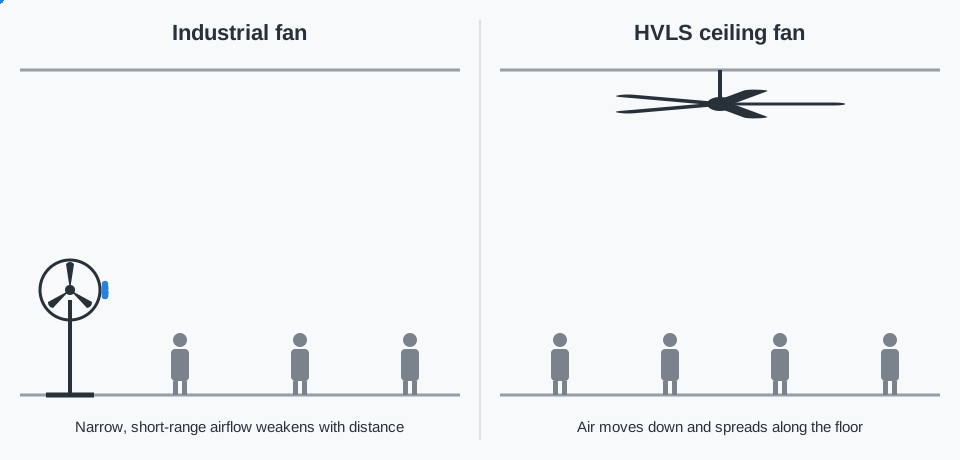
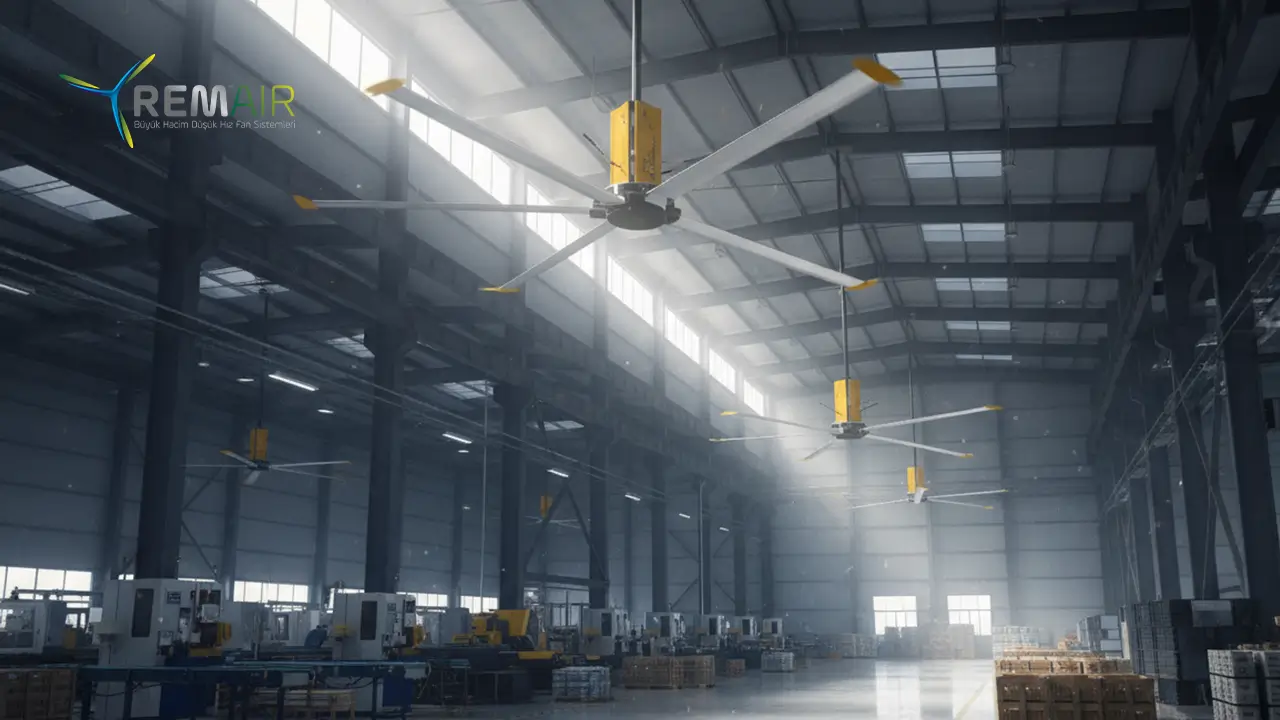
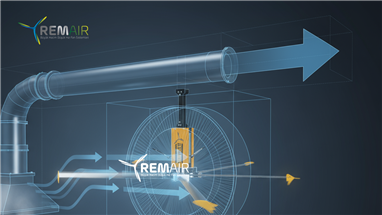
An HVLS ceiling fan turns slowly with blades that span several metres. It pushes a broad column of air down from the ceiling. When the air reaches the floor, it spreads in all directions, creating gentle but continuous airflow across a wide area around the fan. For example, Remair lists a coverage range of 20 metres on the product page for its five-blade, five-metre model.
For a detailed explanation of what HVLS ceiling fans are and where they are used, see our article What Is an HVLS Ceiling Fan and Where Is It Used?
Industrial Fans vs. HVLS Ceiling Fans
| Criterion | Industrial fan | HVLS ceiling fan |
|---|---|---|
| Mounting location | Floor (pedestal) or wall | Ceiling |
| Diameter | Approximately 60–76 cm for common models | 4, 5 and 6 metres for Remair models |
| Airflow | Narrow, fast and short-range | Broad, slow and spreads along the floor |
| Floor space | Pedestal models take up space and require cables | None |
| Noise | Can be noticeable at high speeds | Maximum 51 dB for Remair fans |
| Initial investment | Low per unit | High per unit |
| Portability | Easy to move | Fixed installation |
Energy Consumption: Assess the Entire Area
An industrial fan may appear to use less electricity when units are compared individually. Common models have motor ratings of approximately 130–330 watts. Remair’s five-blade, five-metre HVLS ceiling fan has a 1.1 kW motor.
A fair comparison considers the entire area you want to cool. Covering a large area with industrial fans requires multiple units. You can calculate the total power draw as follows:
- Industrial fans: number of fans required × wattage per fan
- HVLS ceiling fans: number of fans required × motor power per fan
When you run this calculation for your space, you will often find that HVLS ceiling fans have the advantage in large buildings with high ceilings. We discuss how many fans a space needs in How Many HVLS Fans Do You Need for 1,000 m²? and examine their electricity use in How Much Electricity Does a Ventilation Fan Use? in detail.
Noise, Dust and Workplace Safety
Three other considerations are just as important as energy use and often overlooked:
- Noise: Small impellers running at high speed can produce a constant hum, especially when several units run at once. HVLS ceiling fans operate more quietly because they run at low speeds.
- Dust and lightweight materials: The narrow, fast airflow from an industrial fan can stir up dust and blow around paper, stretch film or labels. The broader, slower airflow from an HVLS ceiling fan reduces this effect.
- Walkways and cables: Pedestal fans take up space in forklift and pedestrian routes. Extension cords also create a trip hazard. A ceiling-mounted fan keeps the floor clear.
When Is an Industrial Fan the Better Choice?
An HVLS ceiling fan does not suit every situation. An industrial fan makes more sense in these cases:
- The space is small, such as a workshop with a few people.
- The ceiling is low. Remair lists a blade-to-floor clearance of 3 metres on its product page, so the ceiling must accommodate that clearance.
- You only want to cool one spot, such as a single workbench.
- The unit needs to move frequently or is only needed temporarily.
- The budget is tight and you need a short-term solution.
When Is an HVLS Ceiling Fan More Efficient?
The advantages of an HVLS ceiling fan become clearer as floor area and ceiling height increase. It is especially useful in:
- Factories and production areas: Spaces where many employees work across a large volume. For help choosing a fan, see Choosing the Right Ventilation Fan for Your Factory.
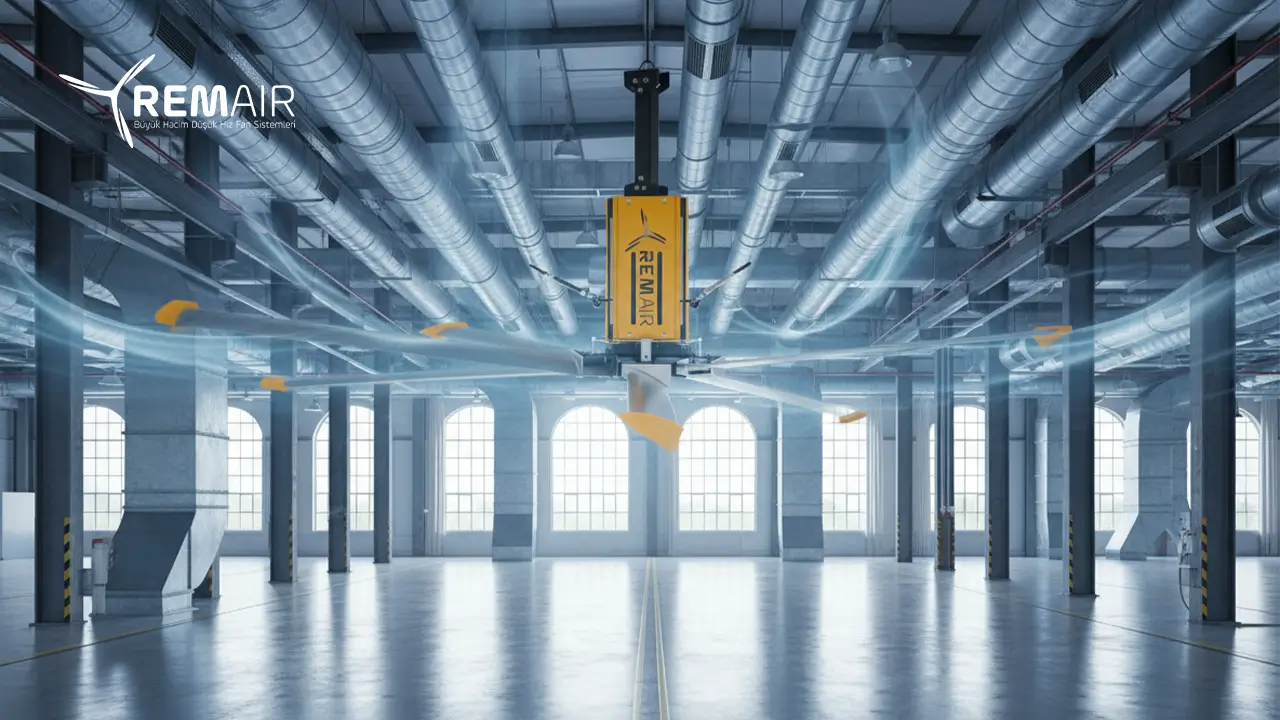
- Warehouses and logistics centres: To circulate air between racks and in loading areas while keeping the floor clear.
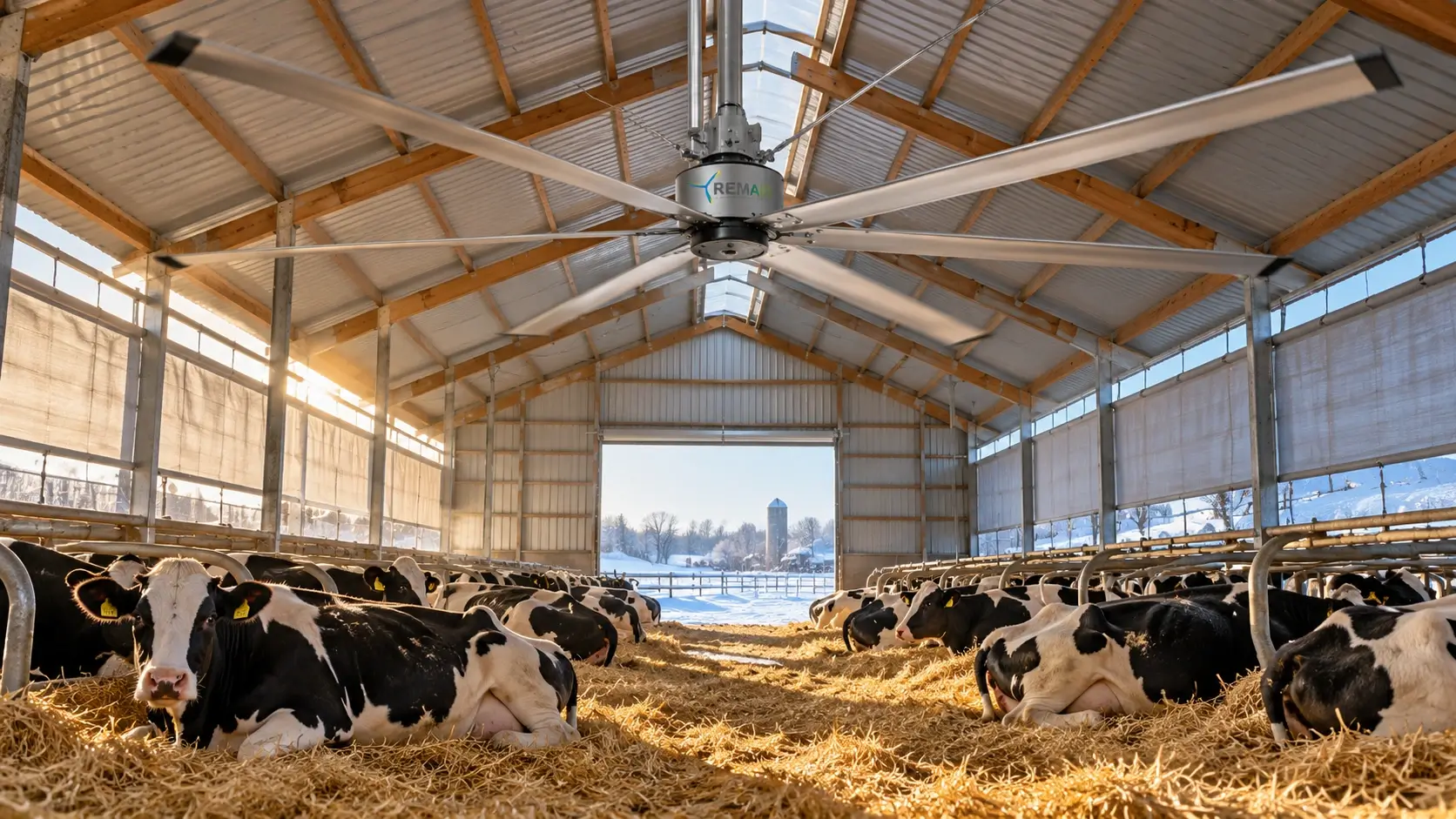
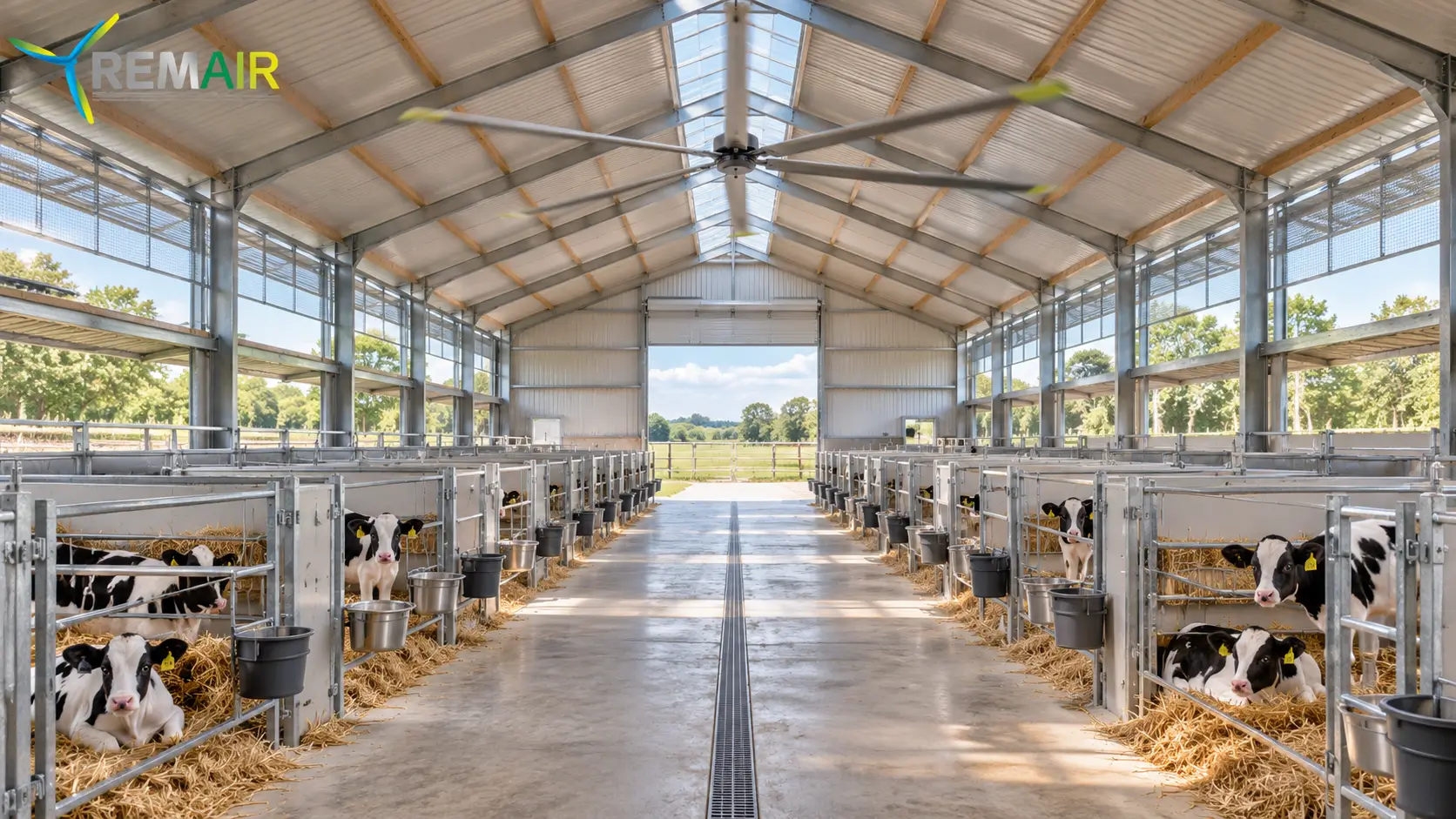
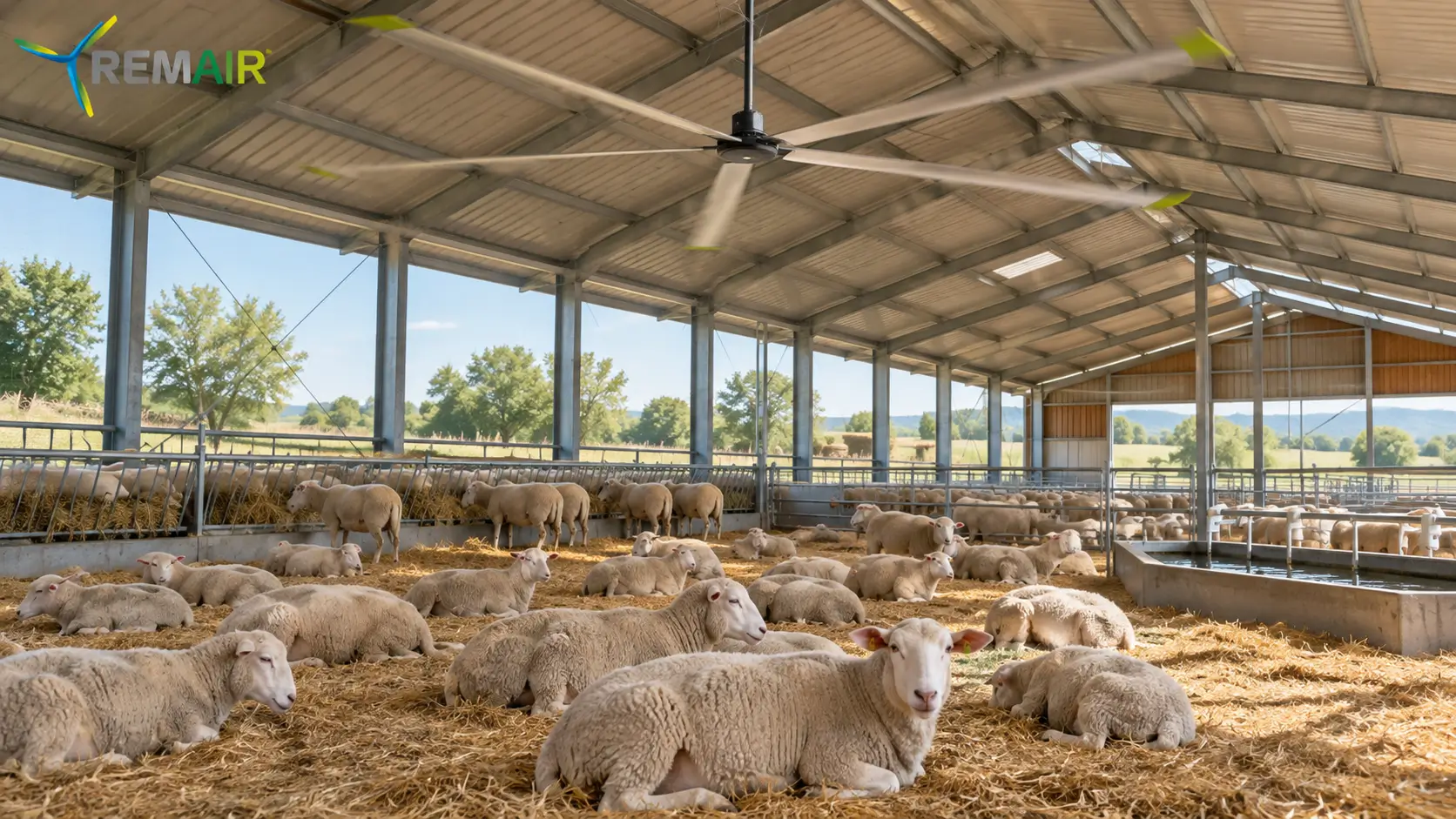
- Barns: Facilities where animals are spread out and heat stress directly affects productivity. For details, see Benefits of HVLS Ceiling Fans in Livestock Farming.
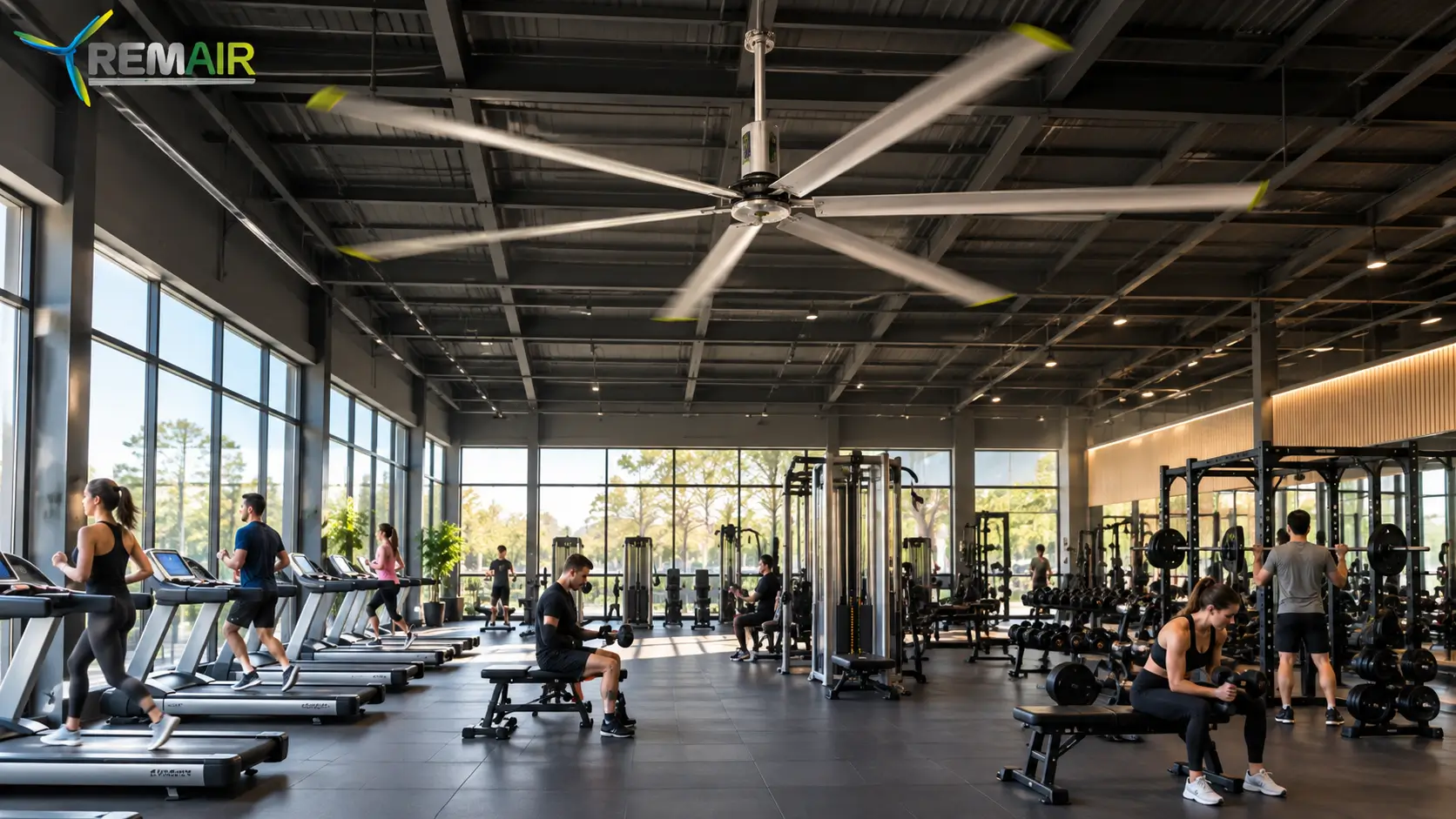
- Gyms and large communal areas: Spaces where quiet operation and appearance matter.
To estimate how long an HVLS ceiling fan will take to pay for itself, see our Guide to Calculating Ventilation System ROI.
Can You Use Both Together?
Yes. Some facilities use HVLS ceiling fans for general air circulation and industrial fans in corners, behind columns or in enclosed areas where the ceiling fans have less effect. In this setup, industrial fans supplement the main system.
To learn how fans work and how they differ from ventilation systems, see What Is an Industrial Ventilation System? and What Is an Industrial Fan? Types and Applications. You can browse all our HVLS ceiling fan models on the Our Products page.
Frequently Asked Questions
How many watts does an industrial fan use?
Common models have motor ratings of about 130–330 watts. Check your unit’s rating plate for the exact figure. In large spaces, the combined consumption of all units required gives a more accurate comparison.
How high should the ceiling be for an HVLS ceiling fan?
Remair product pages specify a blade-to-floor clearance of 3 metres. The suspension system and roof structure must also be considered. To confirm suitability, share your facility’s dimensions via our contact page.
Can you use an industrial fan in a barn?
Yes, but large barns need several units to reach all the animals. The narrow airflow cools only the animals directly in front of the fan. In larger facilities, ceiling-mounted HVLS fans cover more area from a single point.
Is an HVLS ceiling fan much more expensive than an industrial fan?
The initial cost per unit is higher. For a more accurate comparison, consider how many units are needed to cover the entire space, their total energy use and their maintenance needs.
How far does an industrial fan’s airflow reach?
The effective range depends on the model’s diameter and speed. These fans produce a narrow airflow that weakens quickly with distance. Check the manufacturer’s specifications for the relevant figures.

Leave a Comment