
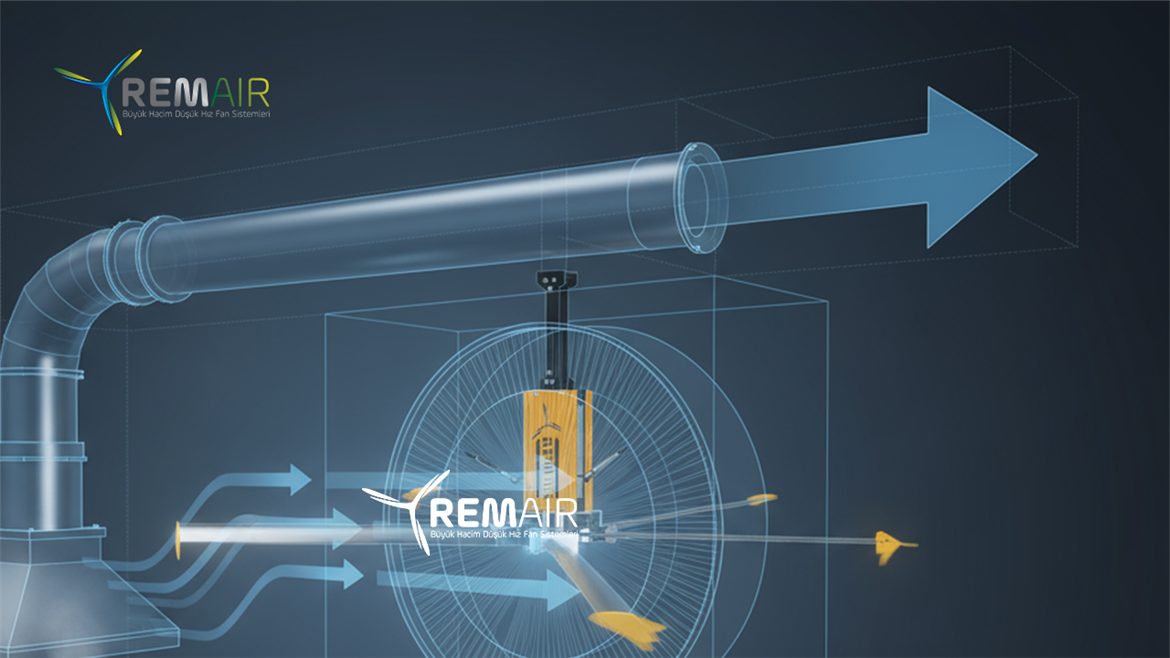
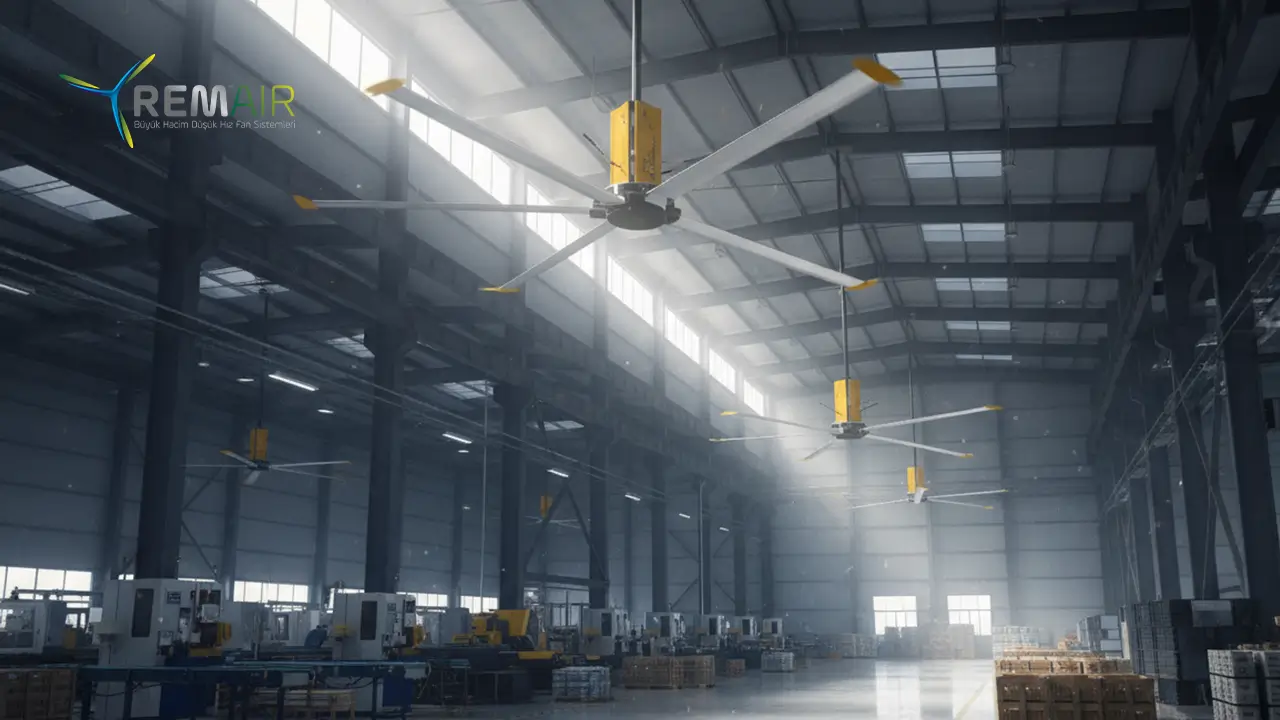

An evaporative cooler cools air by drawing it through wet pads. The cool air it produces, however, is confined to a limited area in front of the unit. An HVLS ceiling fan keeps air moving across a large area without cooling the air itself. Used together, the cooler produces cool air and the fan distributes it throughout the hall, making it feel cooler through air movement.
Three rules help you get the most from this combination. Position the coolers where they can draw in outdoor air. Place the fans so they carry cool air to the work area. Leave an opening on the opposite side for humid air to escape. Below, we explain why these rules matter and what to do on humid days.
How Does an Evaporative Cooler Work?
A fan draws outdoor air through water-soaked pads. As the water evaporates, it absorbs heat from the air and cools the incoming air. This is why some sources also call the device a “water-cooled air cooler” or an “evaporative air cooler.”
The main advantage is low energy consumption. The main limitation is ambient humidity. According to the U.S. Department of Energy guide, evaporative coolers can lower the outdoor air temperature by about 8–22 °C in low-humidity regions. The guide also notes that in homes these units cost about half as much to install as central air conditioning and use around a quarter of the energy. They are not recommended in humid climates (U.S. Department of Energy).
Why Might an Evaporative Cooler Be Insufficient on Its Own?
In large spaces such as factories, warehouses and workshops, a common complaint is that it feels cool right in front of the unit and hot just a few metres away. There are three main reasons:
- Cool air has limited reach. The air from the cooler mixes with surrounding air within a short distance and loses its cooling effect.
- Moisture builds up in one spot. Poor air circulation can make the area around the unit humid and stuffy.
- Covering the whole area takes multiple units. Putting a cooler in every corner increases water use, maintenance and upfront costs.
What Does an HVLS Ceiling Fan Add?
HVLS fans use large-diameter blades that turn slowly to move large volumes of air. When used with an evaporative cooler, they offer three benefits:
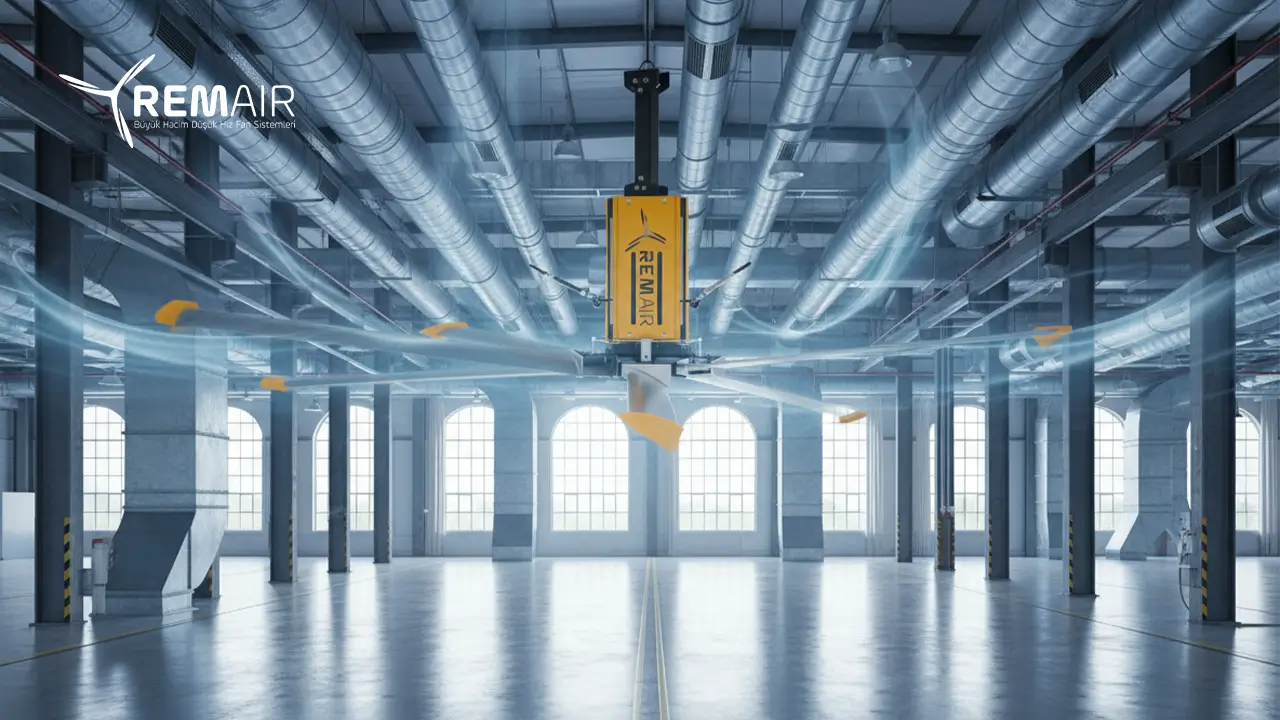
- They distribute cool air. They direct air from above down into the work area and spread it over a wide area.
- They make the space feel cooler. Air moving over the body helps sweat evaporate faster. The space feels cooler even at the same temperature.
- They reduce local moisture buildup. Continuous air mixing keeps humid air from collecting in one spot.
This lets you reach a larger area with fewer coolers.
| Feature | Evaporative cooler | HVLS ceiling fan | Combined |
|---|---|---|---|
| Air temperature | Lowers it | Leaves air temperature unchanged but makes the space feel cooler through air movement | The air is cooler and the space feels cooler |
| Coverage | Limited area in front of the unit | Wide area | Cool air spreads across a wide area |
| Humid days | Cooling effect falls considerably | Air keeps moving | The cooler is turned down and the fan keeps running |
| Water requirement | Requires a continuous water supply | Requires no water | Fewer coolers use less water |
How Should the Units Be Positioned?
Placement largely determines how well the two systems work together. Follow these general rules:
- Position the coolers to draw in outdoor air. An evaporative cooler works best when it draws fresh air from outside and supplies it indoors. Places near an exterior wall, door or window are suitable.
- Leave an outlet on the opposite side. Humid air entering the building needs a way out. A door, window or exhaust fan on the opposite wall can serve this purpose. The U.S. Department of Energy also recommends keeping openings partly open when using an evaporative cooler. Too few openings trap moisture, while too much exposure lets hot outdoor air in.
- Position fans in the path of the cool air. Mount HVLS fans above employees and production lines so they direct the air from the cooler down into the work area.
- Keep the airflow path clear. Tall racks, stacked goods and partition walls between the cooler and the work area can obstruct the spread of cool air.
To calculate how much air exchange your building needs, see How Do You Calculate Air Changes per Hour (ACH) in Barns and Factories? To find out how many HVLS ceiling fans you need, see How Many HVLS Fans Do You Need for 1,000 m²? for details.
What Should You Do When Humidity Is High?
Evaporative cooling depends on how much moisture the air can absorb. When the air is already humid, less water evaporates, cooling performance drops and indoor humidity rises. In Türkiye, humidity is generally high along the Mediterranean, Aegean and Black Sea coasts in summer. Central Anatolia and other inland areas tend to be drier. The same unit can therefore perform differently from city to city.
Practical tips:
- Measure humidity. Put a simple hygrometer indoors and monitor the reading during the hottest hours.
- Turn down the cooler when humidity is high. When humidity rises, switch off the cooler’s water pump and run only the fan to keep the space from becoming stuffy. The HVLS ceiling fan continues to make the space feel cooler through air movement.
- Watch out for moisture-sensitive goods. Higher humidity can damage paper, cardboard, electronics, metal parts or textiles in storage. Assess humidity carefully before using an evaporative cooler in these areas.
What Maintenance Is Required?
An evaporative cooler’s efficiency depends on clean pads and water. The U.S. Department of Energy recommends checking the pads, filters, water tank and pump monthly during hot periods and replacing the pads at least twice during the cooling season. Pads may clog faster where the water is hard. Always follow the manufacturer’s maintenance instructions as well.
HVLS ceiling fans do not use water and do not require this type of maintenance. For details on the fan’s design, see our technology page for more information.
Is This Combination a Good Alternative to Air Conditioning?
In large, high-ceilinged production or warehouse spaces where doors open frequently, cooling the whole building with air conditioning is costly and often impractical. An evaporative cooler and an HVLS ceiling fan offer a lower-energy option focused on the areas people occupy. Air conditioning may still be needed where temperature and humidity must be precisely controlled, such as laboratories or storage for sensitive goods. We compare the systems in detail in Differences Between HVLS Ceiling Fans and Air Conditioning.
See examples from factories and warehouses on our Factory / Industrial page and browse all our models under Our Products.
Frequently Asked Questions
Does an evaporative cooler work in humid weather?
It does, but its efficiency drops considerably and it adds moisture indoors. During humid hours, turning down the cooler and running only the HVLS ceiling fan generally works better.
Can an evaporative cooler be used with the doors closed?
This is not recommended. If humid air has no way out, moisture builds up and the space becomes stuffy. Leave an outlet on the opposite side, such as a partly open door or window or an exhaust fan.
Is an HVLS ceiling fan enough on its own?
In many facilities it is. An HVLS ceiling fan does not lower the air temperature, but moving air can make the space feel noticeably cooler. In areas with very high outdoor temperatures and dry air, adding an evaporative cooler improves the effect. See Solving Heat Problems with HVLS Fans for more on this topic.
How many coolers and fans are needed?
The number depends on floor area, ceiling height, layout and local humidity. A single formula would be misleading. Send us your facility dimensions and floor plan via our contact page.
How much water does an evaporative cooler use?
Water use depends on the unit’s capacity, outdoor temperature and humidity. Check your model’s specifications for the relevant figures. Using HVLS ceiling fans can reduce total water use if fewer coolers are needed for the same area.

Leave a Comment